Multilingual Credit Documentation Accelerates Sanction Letter Turnaround by 4× for a High-Growth Small Finance Bank
Get Summary




About Customer
This work was undertaken for one of the top-tier small finance banks in India, an institution whose growth has been built on disciplined retail lending, distributed branch operations, and a credit process that depends on documentation moving without friction.
In such an environment, language is not a communication layer; it is embedded within the transaction itself. A late, out-of-order, or hard-to-understand sanction letter can change when payments are due, how easy it is to audit the portfolio, and how it can grow into other areas.
The bank's presence expanded across several states, leading to a significant increase in the number and speed of documents customers saw. Every change to a product, policy, or compliance had to be mirrored across a growing number of languages without losing legal or numerical accuracy.
Challenges
The pressure point was not translation capacity; it was synchronization.
Projects ranged from a few hundred words to document sets exceeding 40,000 words, often tied to active lending cycles. Each revision had to appear across all language versions simultaneously. When that did not happen, the consequences surfaced immediately, branches waiting for corrected sanction letters, compliance teams rechecking document trails, operations teams manually validating which version was current.
Document structure introduced its own complications. Financial tables, embedded numeric fields, and tightly formatted legal clauses left little tolerance for layout drift when text expanded in regional languages.
Terminology consistency was equally critical. A variation in phrasing across languages was not a stylistic issue; it altered interpretation in a regulated environment.
What had begun as a manageable documentation workflow was becoming a scaling constraint.
Solution
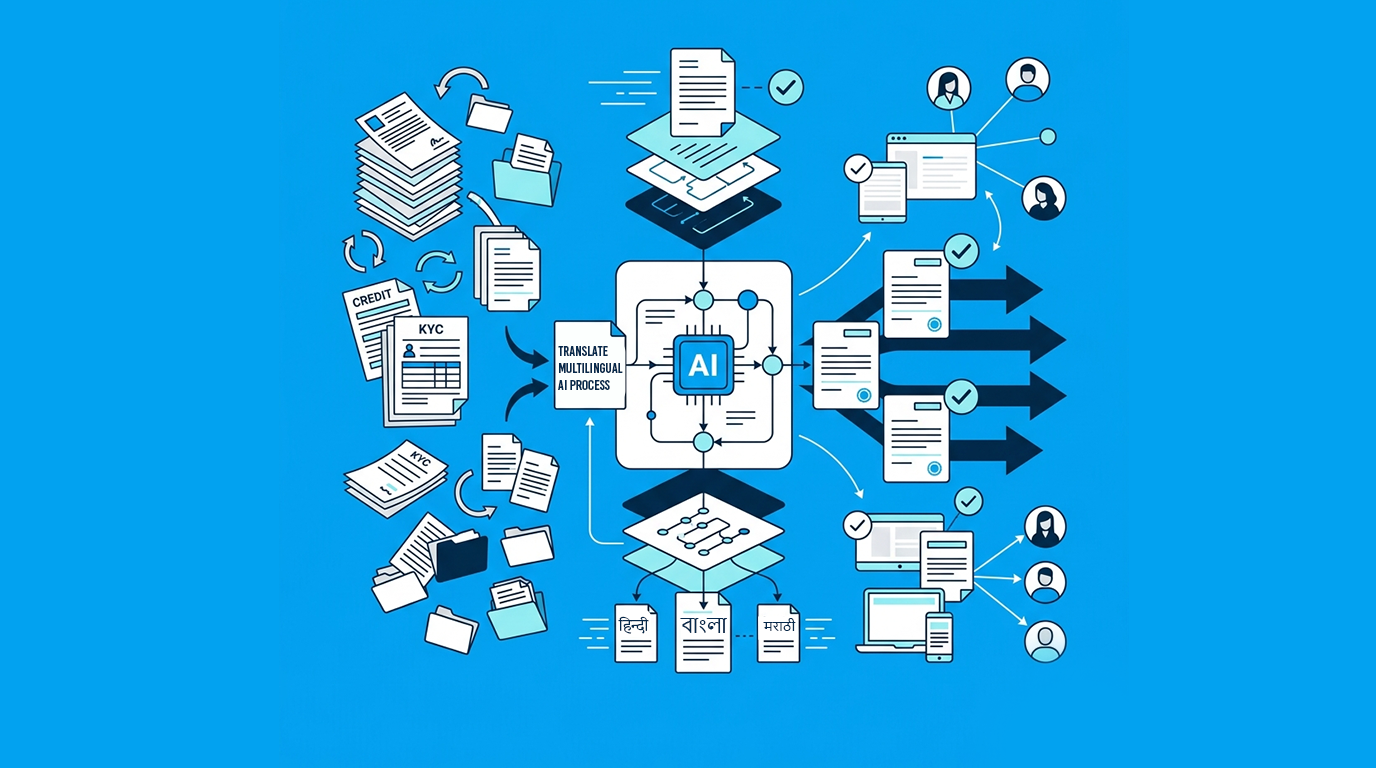
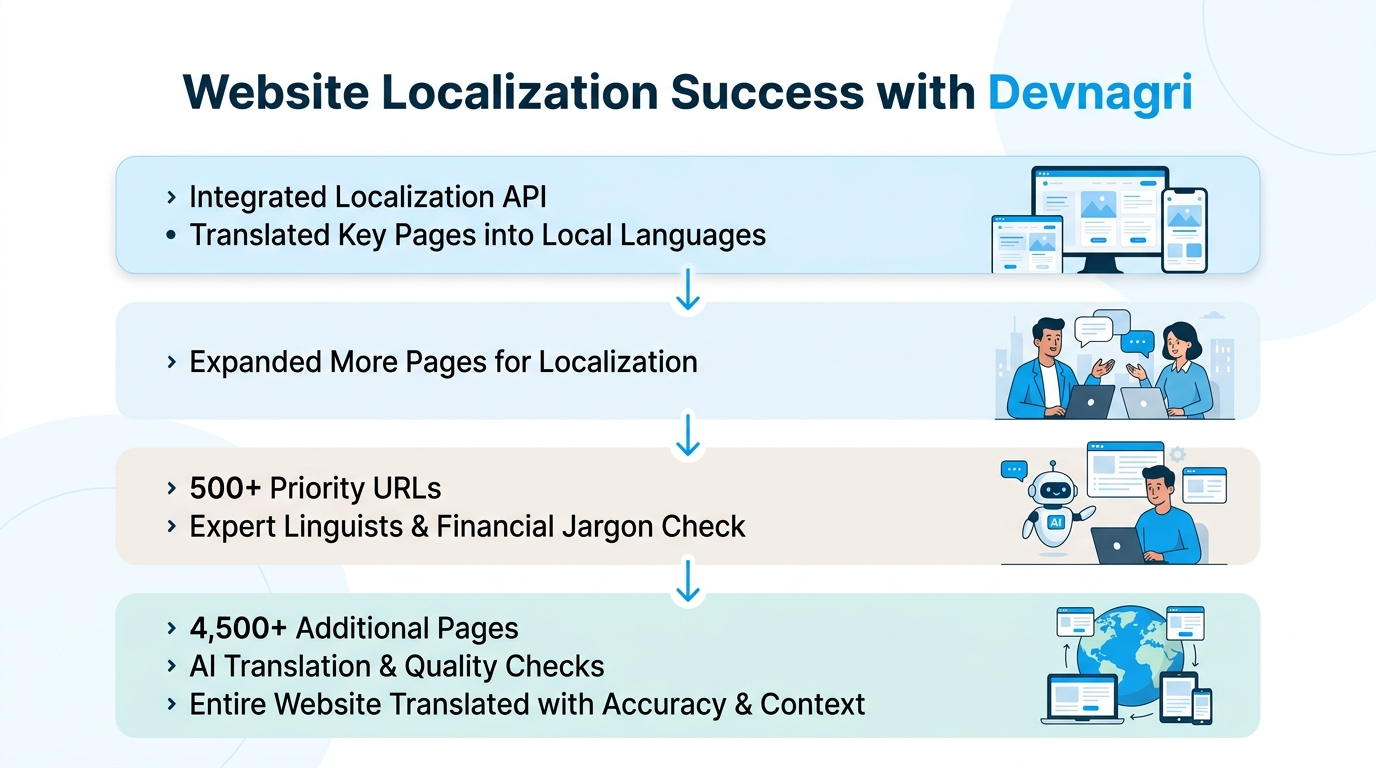
The intervention focused first on the documents that sit closest to revenue realization, loan application forms and sanction letters. Once accuracy and turnaround stabilized there, the model was extended to the broader document ecosystem and web properties.
Financial-domain linguists worked against a controlled terminology base that carried across Hindi, Marathi, Bengali, Tamil, Telugu, Kannada, Gujarati, and Punjabi . The objective was uniform legal meaning rather than linguistic equivalence.
A version-controlled production environment replaced the earlier linear flow. Source changes triggered parallel multilingual updates, removing the need for downstream reconciliation between teams.
Formatting was treated as a core workstream. Desktop publishing processes were engineered to accommodate language expansion while preserving tables, numeric data, and clause structures, an essential condition for audit acceptance.
Quality checks were deliberately separated: language accuracy, number validation, and compliance alignment did not occur in a single pass. Urgent revisions, particularly those affecting live loan cycles, moved through a defined rapid-response track that operated within the same control framework.
The effect was to shift multilingual documentation from an ad hoc activity to a repeatable production system.
Key Highlights
- Credit-cycle–aligned multilingual workflow
- Controlled cross-language legal and financial terminology
- Parallel document processing replaces sequential dependency
- Layout engineering for compliance-bound formats
- Distinct validation layers for audit reliability
- SLA-backed execution for time-sensitive sanction letters
Impact
Sanctions letters began moving at the pace of credit approvals rather than lagging behind. Turnaround time improved by a factor of 4.2, removing a persistent bottleneck in the disbursement cycle.
Manual reconciliation between operations, compliance, and documentation teams dropped by roughly two-thirds , releasing capacity for core lending activities. Large document batches that previously moved in stages were processed concurrently, cutting overall cycle time by more than half.
Equally important, document interpretation became consistent across regions. Borrowers received agreements and product information in their primary language with the same legal and financial meaning as the source version, reducing clarification loops at the branch level and improving completion rates.
What the bank now operates is not a translation program but a multilingual documentation infrastructure that scales with portfolio growth. It supports faster entry into new linguistic markets, sustains regulatory discipline, and keeps the credit process aligned with business velocity rather than administrative constraint.