7+ Indian Languages 500+ Web Pages Localised For One Of India's Leading Real Estate Developers

Get Summary




The customer is a renowned real estate developer in India. Their projects attract interest from people across the country, many of whom are far more comfortable reading in their native language than in English.
Over time, their website grew into something more than a project showcase. It became the first serious interaction point. Buyers would browse listings, compare options, and form early impressions based on what they read there. This also meant that when the content did not connect, the opportunity often did not either.
The Challenge
What started as a straightforward idea — make the website available in multiple Indian languages — turned out to be considerably more layered in practice.
There were already 500+ pages live. New ones kept getting added. And this was not lightweight content. Each page carried real weight: project specifications, amenity details, and location context. Even a small error in translation could create confusion at the moment a buyer was trying to make a decision.
A few things made the work harder than it might have looked at first:
- Real estate terminology rarely translates cleanly across seven or more languages
- The brand voice had to stay consistent whether the page was in Hindi, Tamil, or Marathi
- New project launches meant frequent content updates
- Timing mattered — delayed translations meant slower buyer response
The problem, in other words, was not just translation. It was how to keep everything current, accurate, and consistent without creating friction inside the business every time something changed.
The Solution
Rather than treating the project as a one-time translation exercise, the approach shifted toward building something repeatable.
The first phase focused on a smaller set of high-traffic pages. That gave enough surface to establish the baseline — what tone works, how specific terminology should be handled, and what level of detail is appropriate for each content type. Getting that foundation right mattered more than moving fast early.
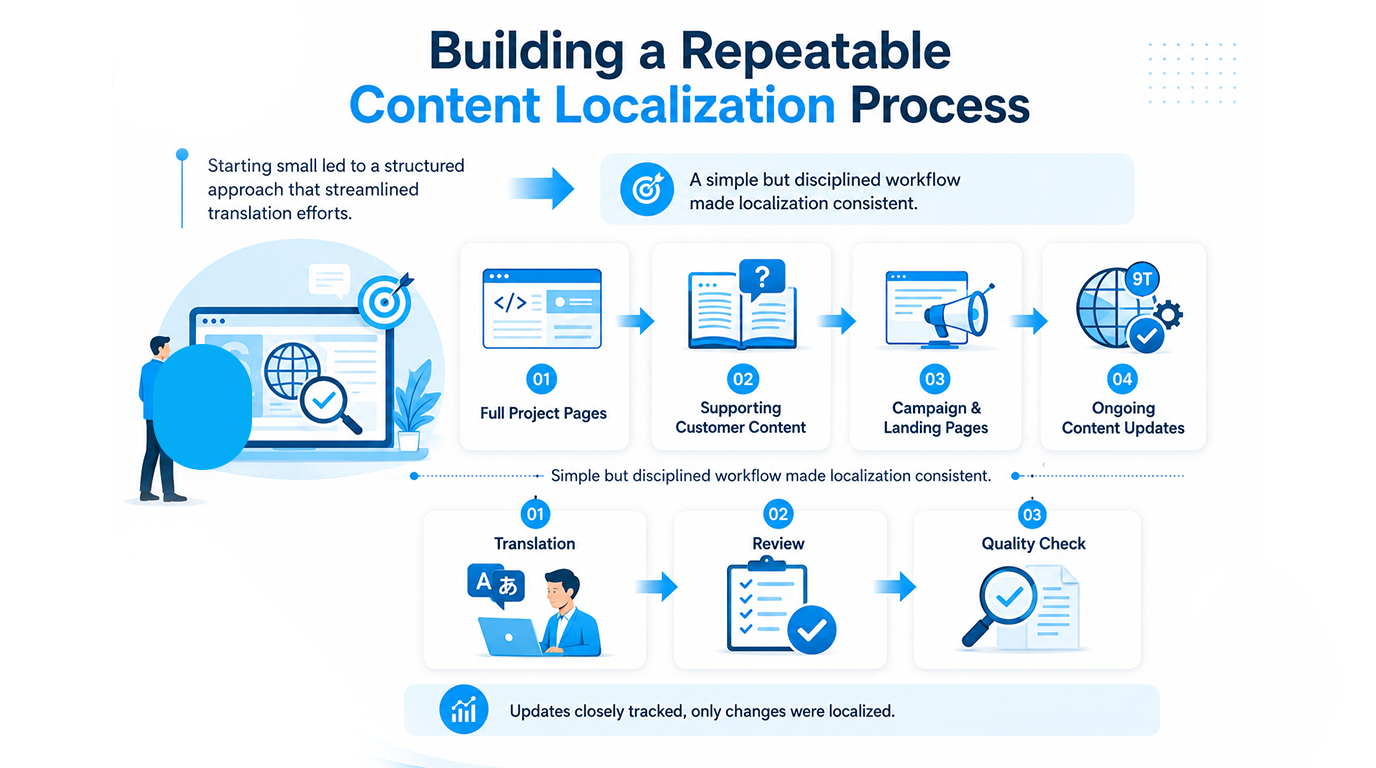
From there, the scope expanded steadily:
- Full project pages
- Supporting customer-facing content
- Campaign and landing pages
- Ongoing updates as new content came in
Behind the scenes, a disciplined three-stage workflow carried the quality: translation, review, and quality check. Not complicated, but structured enough to catch inconsistencies before they reached the live site.
Update tracking made another meaningful difference. Instead of reworking full pages every time something changed, only the updated sections were picked up and localised. That single process change eliminated a significant amount of unnecessary back-and-forth and kept turnaround times predictable.
Key Highlights
- More than 500 pages handled across the website
- Coverage across 7+ Indian languages
- Consistent three-step workflow applied to every piece of content
- Ongoing support rather than a one-time delivery
- Careful handling of real estate-specific terminology throughout
Impact
The results did not arrive as a single spike. They showed up as a gradual but clear shift in how the website started working for different users.
Now buyers from different regions can check project specifics without dealing with language barriers. That made browsing easier, but more crucially, it made decisions clearer. A reader who can make sense of what they are reading will progress with more confidence.
Things improved internally as well. The team no longer had to track whether updates had been reflected across all language versions. New launches could go live without waiting on translations to catch up.
Over time, a few specific changes became visible:
- Faster turnaround when content needed updating
- Fewer inconsistencies between language versions
- Higher engagement from users who do not read in English
And, broadly, a better experience for a meaningfully larger audience.
None of this required a structural overhaul. It required a more organised approach to something the organisation was already doing. Once that structure was in place, scaling it became considerably easier.