Devnagri Enabled Multilingual Education Across 9 Indian Languages for 1+ Million Learners
Get Summary




The customer is a national education organisation that works directly with secondary school students in classes 9 to 12. Their programmes blend in-person learning, printed materials, and digital education initiatives. The mission is straightforward, even if the execution is anything but: make quality education genuinely accessible, across regions, languages, and delivery formats.
As these programmes expanded into more states and communities, language ceased to be a background consideration. It became both a responsibility and a real operational challenge. Every piece of content had to be accurate, culturally appropriate, and written in a way that a student could actually understand, regardless of which language they grew up learning in.
The Challenge
When the organisation began looking for a localisation partner, they wanted one they could rely on for the long haul, not a vendor for one project, but a partner for an evolving programme.
The initial scope was modest: proofreading workshop modules for students. But programs rarely stay modest. New content types emerged quickly. School activity documentation, brochures, and scholarship letters all needed multilingual handling. Then learning itself began shifting, from print to digital. SCORM-based e-learning modules arrived, bringing their technical demands on top of the linguistic ones.
The challenge was never just translation in isolation. It was consistency across content types, speed across languages, and the ability to manage high-volume, recurring education content while maintaining quality and timelines as the programme continued to grow.
The Solution
The partnership started with a focused proofreading pilot: student workshop modules in Hindi, Kannada, and Assamese. That pilot stage was about more than checking language. It was about getting the academic tone right for students in grades 9 through 12, establishing quality benchmarks, and proving that turnaround expectations were realistic. It worked.
From there, the engagement grew naturally. Devnagri moved into full-scale localisation across Telugu, Tamil, Malayalam, Marathi, and Punjabi. Desktop publishing support meant that printed materials arrived ready to use, not as raw translated files requiring further formatting work. Language and design moved together.
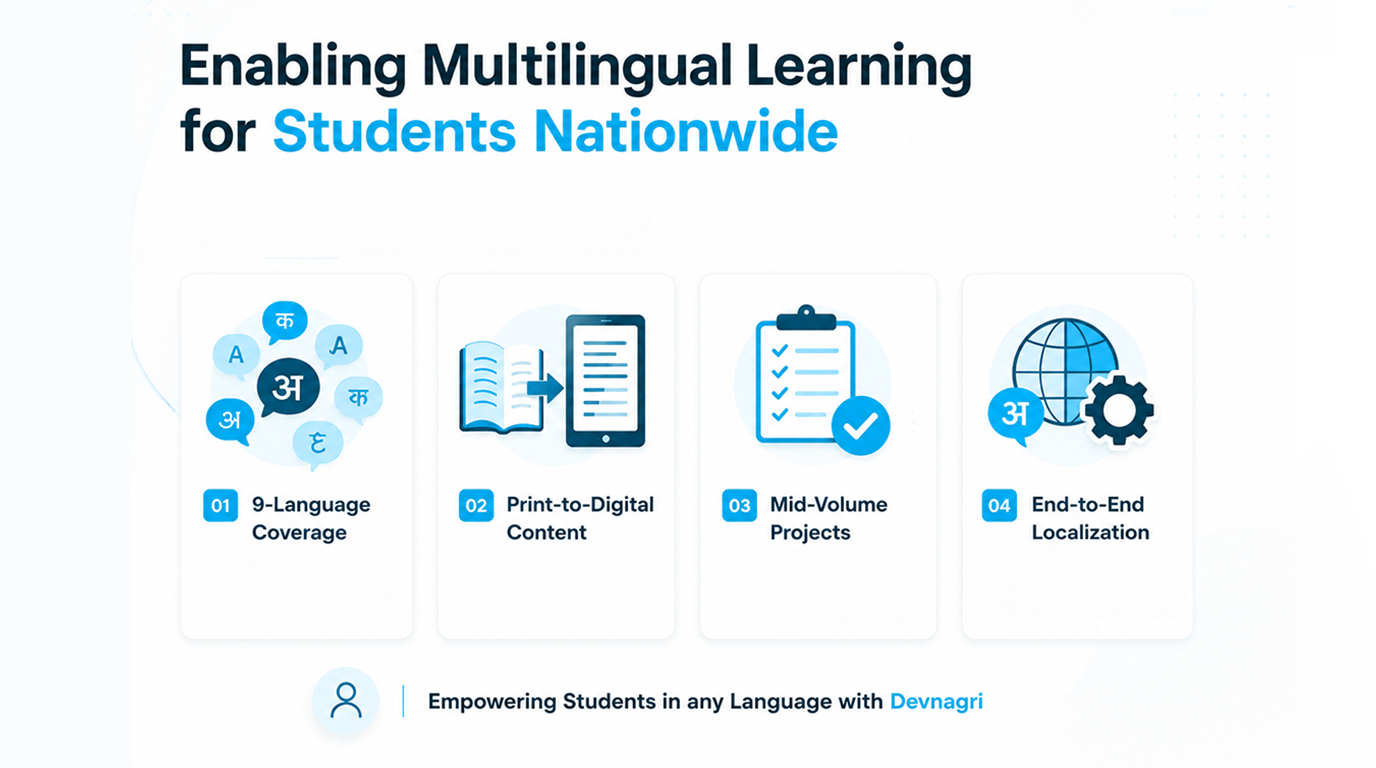
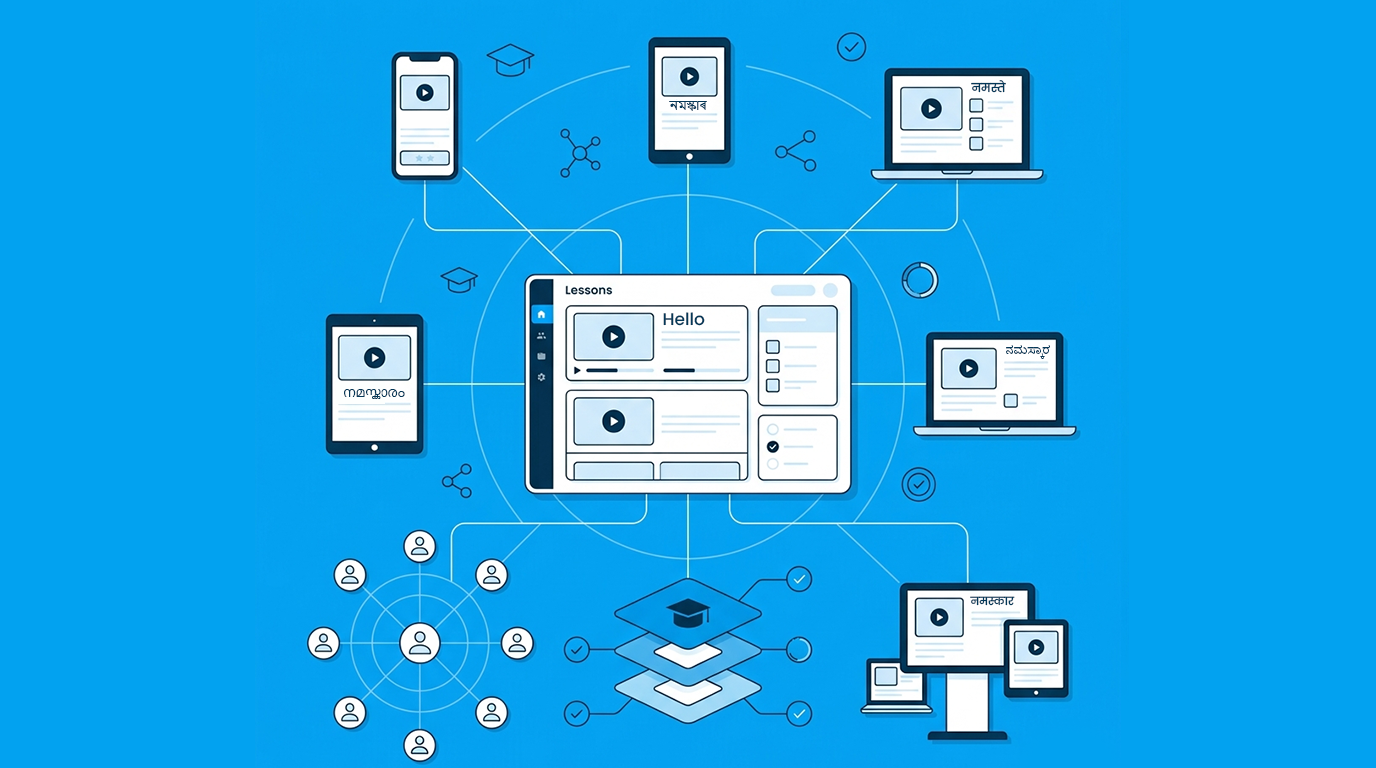
As digital learning projects grew, Devnagri took on end-to-end SCORM localisation. That meant extracting story content, transcribing audio, translating and recording voice-overs, reinserting audio into modules, and repackaging the final SCORM files in deployment-ready formats. The entire process, linguistic, technical, and production, was handled within a single organised workflow.
Key Highlights
- One localisation partner across 9 Indian languages
- Covers print materials, communications, and digital instructional content
- Regular project volumes ranging from 500 to 2,500 words
- Combined language, design, and SCORM technical capability under one roof
- Scalable processes built to support ongoing education initiatives
Impact
Content localisation timelines reduced by over 60%.
Localised learning resources reached more than 1 million students, helping educational content become more accessible and understandable across diverse linguistic communities.
Consistent quality was maintained across thousands of pages and modules, while more than 100 SCORM modules were delivered in deployment-ready formats.
Single-vendor coordination significantly reduced internal project management overhead, allowing teams to focus on educational outcomes rather than localisation logistics.
The organisation now moves faster and with considerably more confidence when it comes to multilingual content. With Devnagri as their localisation partner, they do not have to work around language as a problem. It has grown into a strength, one that propels growth, inclusion, and long-term results in classrooms and digital learning environments alike.