Leading Consumer Credit Company Operating 42% Faster with Document Translation

About the Customer
Our customer is one of India's most renowned banks because they are a well-known financial organization. For decades, the bank has been helping both businesses and individuals. They've always tried to stay in touch with clients from all walks of life by sticking to their traditional ideals and coming up with new ideas.
Challenge
They have regulated, customer-facing communications where a single mistranslation could trigger a compliance review or worse. On one hand, deadlines are breathing down their neck. On the other hand, regulators are unforgiving of even a single misplaced word.
The issues weren't minor either. Translations took longer than preparing the documents. A "minimum due" here, an "overdue charge" there, little inconsistencies that confused customers and annoyed compliance teams. And for a brand trying to win trust in Tier-2 and Tier-3 cities, the lack of local-language reach felt like leaving money on the table. They had vendors, yes, but too many, each with its own processes, none speaking to the other.
Solution
We knew dropping in a generic translation service wouldn't work. This meant they needed a system that could handle banking-specific terms, work on a large scale, and fit right in with their current document lifecycle. We used secure APIs to connect our AI-powered document translation engine directly to their content pipeline.
The system pulled files directly from their content management tool, processed them through an AI-driven translation layer tuned for BFSI vocabulary, and then passed them to human linguists who understood the stakes. These weren't just language experts, they had experience working with RBI-mandated communication and financial disclaimers.
For high-volume runs, we automated glossary enforcement. That meant "EMI" stayed "EMI" everywhere, no matter the language. The review process became parallel rather than sequential, cutting days off delivery. Compliance kept track of every modification, so there were no surprises and no lost versions.
Key Highlights
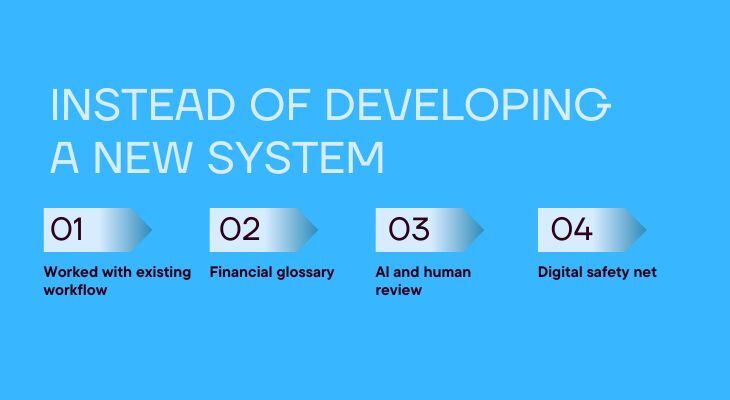
Instead of developing a new system, we worked with their existing workflow. Our API hooked straight into their document workflow, making it feel familiar.
We put in place a financial glossary that became the single source of truth, eliminating the uncertainty of whether "grace period" meant the same thing across three states. AI handled the heavy lifting for speed, but a human, fluent in both banking lingo and the target language, had the final say.
Every file got its own "digital safety net", automated checks that flagged missing numbers, broken formatting, or skipped disclaimers before the document ever went live. And since everything lived in one secure space, compliance could pull up any version without hunting through email chains.
Impact
The First-Time-Right (FTR) rate went up by 33%, which means there were one-third fewer revision cycles.
- The time it takes to deliver documents has gone down by 42%.
- After localized information was rolled out, consumer satisfaction scores went up by 14–17% in Punjab, Maharashtra, and West Bengal.
- Internal email queries about document status dropped by over 60%, freeing up hours of staff time each week.
By month three, the customer's content and compliance teams were working in lockstep without the old bottlenecks. One of their project leaders even commented, "We don't talk about translation as a problem anymore; it's just a process."