Devnagri MT Made Multilingual Compliance 3X Faster for a Financial Institution
Get Summary




About the Customer
We began working with a leading bank that provides tailored business loans to meet a variety of business needs and is opening new branches across India. Customers couldn't talk to each other because of the language barrier, even though the lending and investment goods were already good. Their staff sent out thousands of documents every day, like loan agreements, sanction letters, and client forms. Most of them were only in English. For a customer base that was quickly moving into Tier-2 and Tier-3 cities, this was creating operational and communication challenges.
Challenge
One of the first things we noticed was the gap between what the company wanted and the level of customer comprehension.
Here's what was happening in actual operations.:
- Customers were dropping out midway through the onboarding process.
- Support teams were handling the same questions repeatedly due to a lack of understanding of the documents.
- Compliance personnel had a hard time making sure that customers fully understood the rules and regulations.
- Manual translation was proving to be slow, inconsistent, and costly.
In reality, they needed more than translation. They wanted a means to scale multilingual documentation without compromising accuracy or slowing down commerce.
Solution
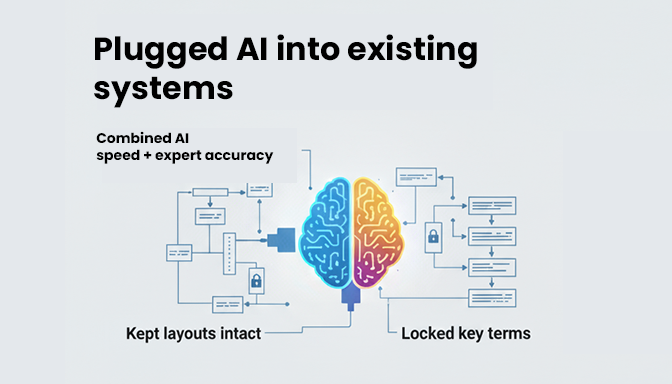
We choose to link our Document Translation process to AI. We ensured seamless integration without altering their existing workflows. Instead, we worked with the systems they already had.
- First, we built connectors to pull structured content out of their document management platform. This way, translated copies retained identical formatting and structure to the originals, layouts, tables, and numbering intact.
- Next, we rolled out a financial glossary. Terms like repayment tenure and foreclosure clause had to mean the same thing in every language. We “locked” those terms to maintain consistency across all translations.
- Finally, we used a hybrid model. AI did the high-volume processing, while domain reviewers stepped in for sensitive legal language.
This mix gave them the best of an optimal balance between scale and precision, scale plus accuracy.
Key Highlights
- We translated documents into seven different languages spoken in the region.
- Direct integration with their current systems, with no need to change the way things work.
- SLA-backed turnaround in less than 48 hours for large batches.
The compliance team authorized the output without needing any changes to the original English documents.
Impact
After the rollout, the results were clearly measurable.
Document processing became three times faster than before. Onboarding rates in regional markets increased, while drop-offs decreased by 40%. The number of call center tickets related to document comprehension declined by 60%, indicating better user understanding.
Within six months, CSAT in semi-urban areas rose by 35%. Being able to speak more than one language has gone from being something you have to do to something that helps your business run more smoothly and keep customers interested.