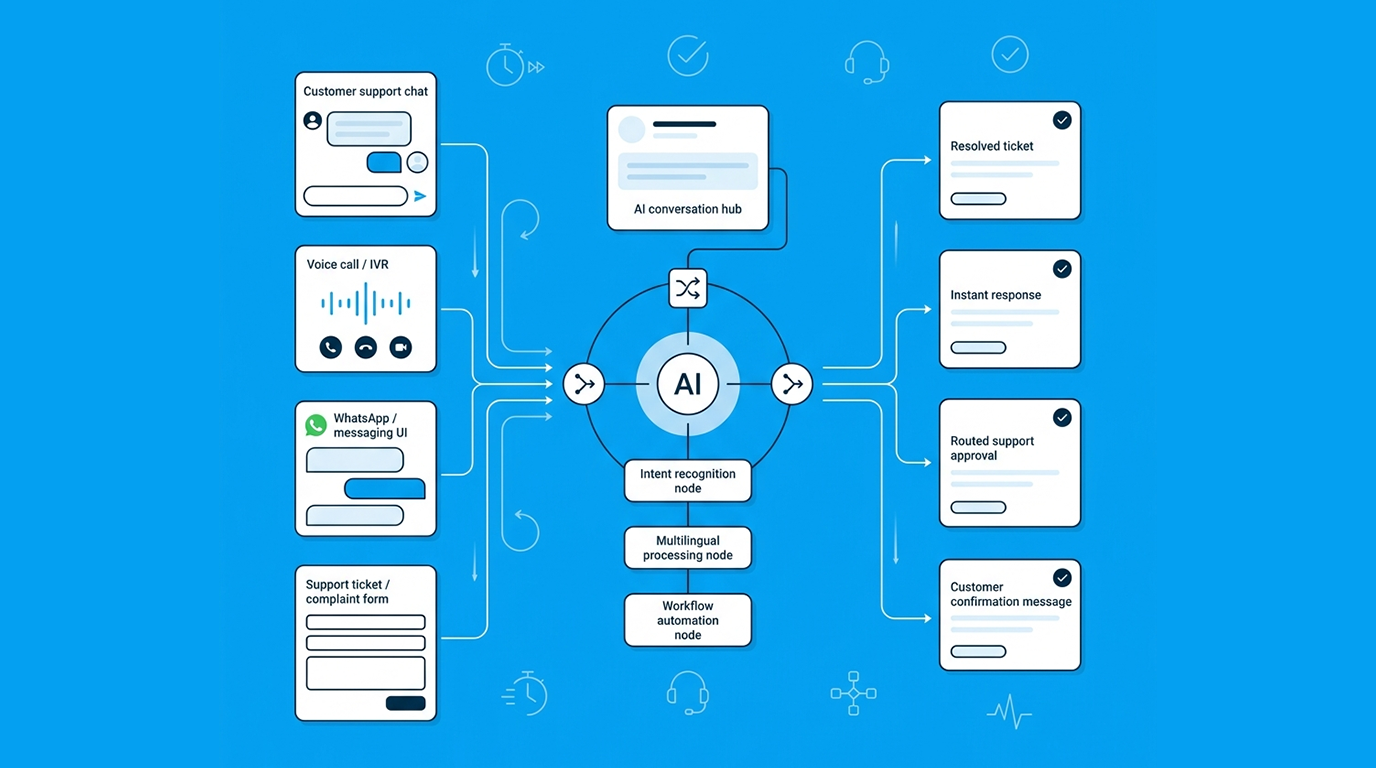
Every enterprise has a grievance handling problem. Most just don't measure it carefully enough to feel the full weight of it.
Customer complaints arrive across channels: email, phone, web forms, WhatsApp, and social media, and somewhere between submission and resolution, time disappears. An agent picks up the ticket. It gets miscategorized. It's routed to the wrong team. A supervisor escalates it. Three days later, the customer is still waiting for an acknowledgement.
This is not a people problem. It's a process architecture problem, and conversational AI for enterprise customer support specifically solves it.
In markets like India, where enterprises serve customers across dozens of languages and communication preferences, the complexity compounds fast. The question isn't whether to automate grievance handling. The question is how to automate it in a way that actually works at scale, across languages, channels, and compliance requirements.
This piece examines how conversational AI reduces complaint resolution time structurally, not just theoretically.
Why Does Customer Complaint Resolution Take Time in Enterprises?
The average enterprise customer support operation is held together by a combination of rule-based ticketing systems, manual triage, and agent intuition. Each of those creates friction.
Manual ticket handling is the first bottleneck. A complaint arrives, gets logged, and sits in a queue. In large enterprises, where the queue is usually long, resolution time starts accumulating before a single agent has even read the ticket.
Routing errors compound the problem. A billing complaint routed to the technical support team. A product defect complaint sent to the collections desk. These misdirections are common, and each one adds hours or days to the resolution cycle.
There is a structural ceiling built into agent reliance. Human agents can only handle a finite number of interactions per day. During peak periods, month-end surges, and festival seasons, policy renewals and volumes spike, and wait times balloon. There is no elastic capacity in a purely human-driven model.
Language barriers are a final and often underestimated variable. In any multilingual market, a customer who raises a complaint in Marathi or Bengali may wait significantly longer than one who writes in English, simply because the routing infrastructure isn't built to handle regional language input with equal speed or accuracy.
What Is Conversational AI in Customer Service
Conversational AI is not a chatbot. The distinction matters, and it matters commercially.
A chatbot follows scripted decision trees. It answers FAQs and deflects. Conversational AI understands intent; it can interpret natural language input, extract the relevant complaint type, cross-reference customer history, and take action or route accordingly. It operates across channels: chat, voice, messaging platforms, and increasingly, voice assistants embedded in IVR systems.
The enterprise-grade version of the software goes further. The best conversational AI platforms for large enterprises connect to CRM systems, ticketing infrastructure, and compliance frameworks; until they don't sit alongside the workflow, they sit inside it.
Read Also: What is a Conversational AI Voice Bot? Benefits, Use Cases, and How to Use It
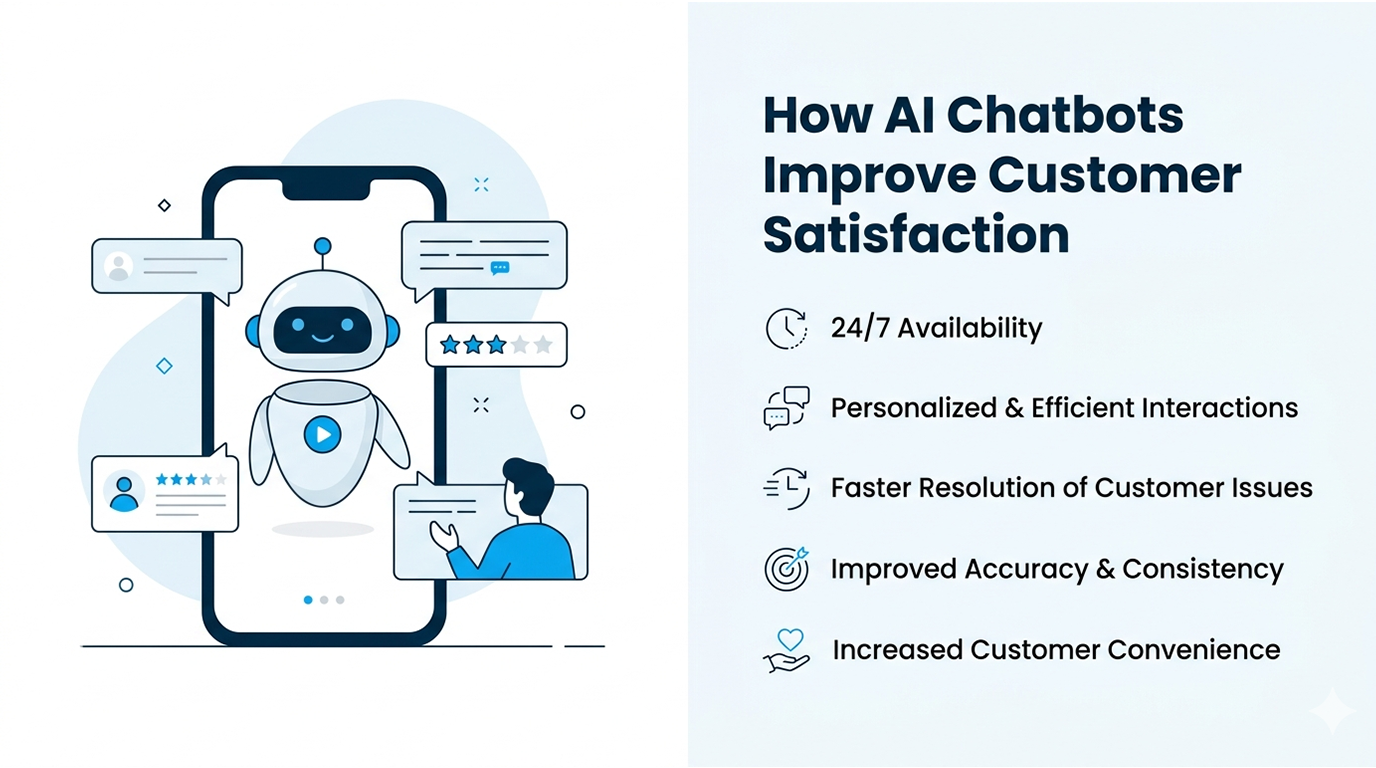
How Conversational AI Reduces Customer Complaint Resolution Time
Instant Response to Customer Queries
The first response metric is where conversational AI delivers the most immediate, measurable impact. A consumer who complains at 11pm on a Saturday no longer has to wait till Monday morning. The AI reacts in seconds, understands the issue, gathers the relevant information, solves it immediately, or creates a structured ticket.
This is about more than convenience. First response time is a major indicator of customer satisfaction rankings.
Automated Ticket Classification and Routing
Intent recognition is where AI earns its keep in complaint management. When a customer says, "My EMI was deducted twice," the AI identifies the issue as a billing dispute, extracts account context, and routes it to the financial reconciliation team in real time, without human triage.
This removes the most expensive step in traditional complaint handling: the moment a human reads a ticket, decides what it is, and decides where to send it. Multiply that step by thousands of daily complaints, and the cost of getting it wrong becomes visible quickly.
24/7 Customer Support Availability
Grievances don't follow business hours. Conversational AI provides continuous handling: every complaint acknowledged, every query tracked, and every escalation initiated, regardless of the time or day. For enterprises managing large customer bases across time zones or regional markets, the priority is operational continuity, not a feature.
Multilingual Customer Support at Scale
Scaling multilingual communication with AI is where the structural advantage of conversational AI becomes most pronounced. A customer who submits a complaint in Tamil or Gujarati receives the same response speed and quality as one who writes in English.
This requires more than basic translation. It requires language infrastructure built on domain-aware models, systems that understand the intent and the terminology of the sector, not just the words.
Personalized & context-aware replies
Repeat contacts are a cost driver in customer support that hits silently. When a consumer calls back after having a billing complaint last week, they shouldn't have to start explaining the problem all over again.
Conversational AI with CRM integration remembers the last conversation, understands the current context, and responds as per the customer's history. That cuts average handle time, reduces repeat contact rates, and in regulated sectors, creates an auditable history of interactions that compliance teams can really use.
Conversational AI Workflow for Complaint Handling
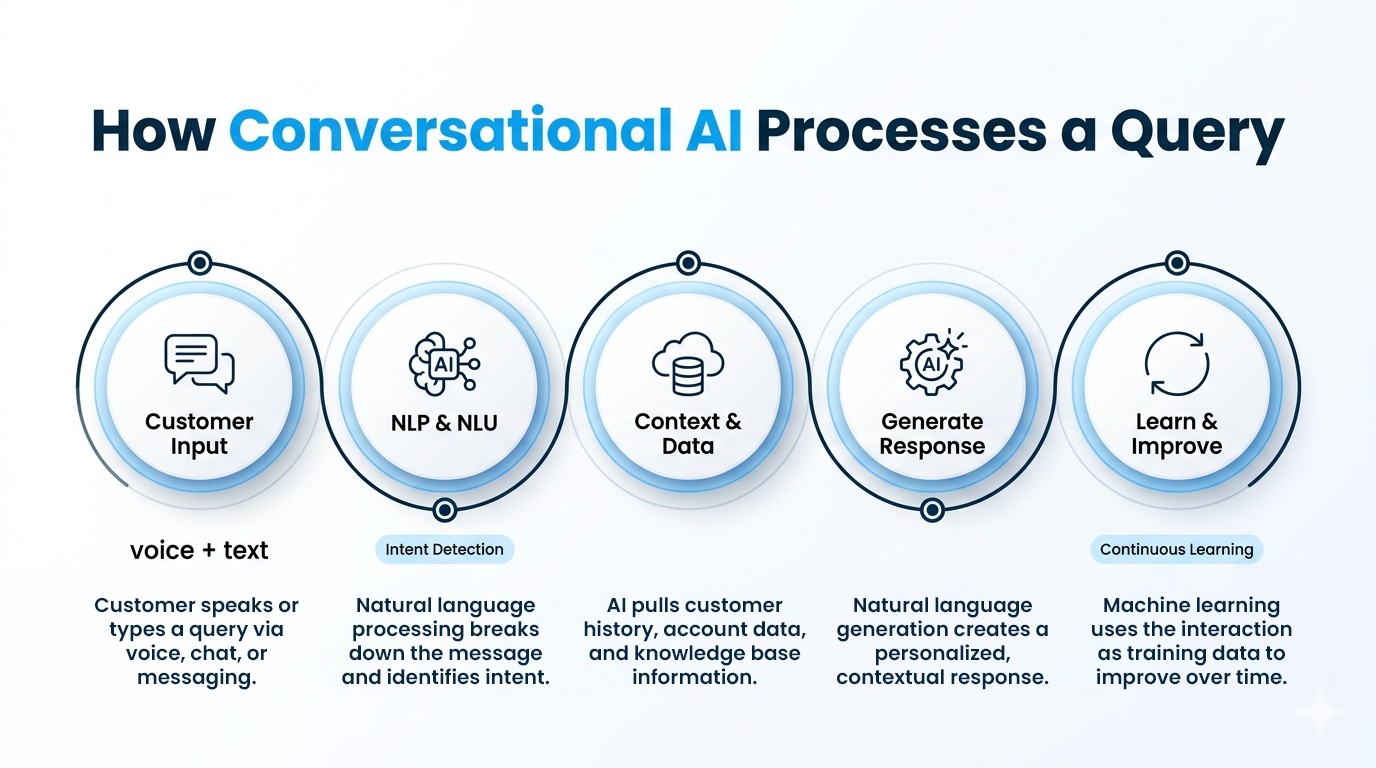
Here's how a well-designed conversational AI system really handles complaints in banking, insurance, or government, step-by-step, without the customary hand-waving.
Complaint Intake. The customer raises an issue through chat, voice, or a messaging app, in whatever language they're most comfortable with. No language menus. No "press 1 for English." They just speak or type, and the system listens.
Intent Recognition. The AI doesn't just read the message. It understands it. It identifies what the complaint is actually about, then quietly pulls the relevant details, account number, transaction ID, and policy reference, without asking the customer to repeat themselves three times.
Instant Resolution. If the complaint already has a fixed resolution registered then AI resolves it instantly. If it doesn't, it builds a structured ticket, fully loaded with context, so nothing is lost when a human eventually picks it up.
Automated Routing. The ticket doesn't sit in a general queue waiting for someone to figure out where it belongs. The AI assigns it immediately, the right team, and the right priority, based on what the complaint actually is and who's available to act on it.
Live Status Updates. The customer doesn't have to call back and ask what's happening. The system tells them proactively, at each stage. That alone eliminates a significant chunk of inbound follow-up volume.
Escalation Logic. If the SLA window closes without a resolution, the AI escalates. Automatically. No reminders needed, no supervisor manually checking a dashboard.
For a large proportion of complaint types, none of this requires a human hand. For the ones that do, the AI has already laid the groundwork, so when an agent steps in, they're walking into a briefing, not a blank page.
Benefits of Conversational AI in Customer Complaint Management
The headline benefit, reduced resolution time (TAT), is real and measurable. But the downstream effects are equally significant.
Lower operational cost is a direct outcome of reduced agent dependency. Gartner estimates that a single automated customer self-service interaction costs a fraction of a live agent interaction, and as AI handles higher volumes, the cost curve flattens even as complaint volumes grow.
This reduces the burden on the call center, so human agents can focus on the high-complexity, high-sensitivity issues where empathy and judgment really count, rather than using up resources on repetitive, low-complexity requests.
Then customers are more satisfied. Faster resolution, consistent communication, and proactive updates transition the customer experience from reactive to managed. Forrester reports that organizations using conversational AI at scale have already seen substantial improvements in Customer Effort Score and CSAT within the first two quarters of deployment.
Conversational AI Use Cases in Complaint Handling
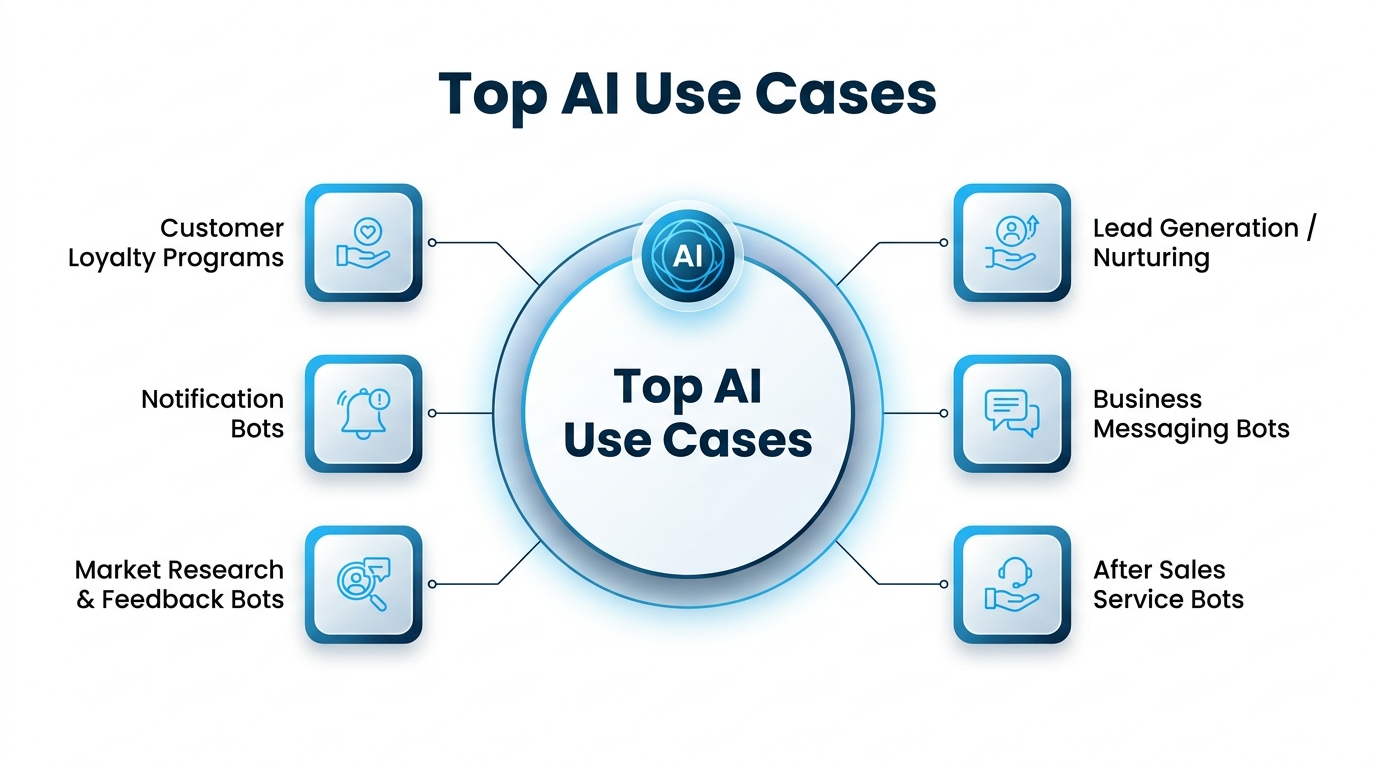
Customer Complaint Resolution BFSI
In banking and insurance, complaint volumes are high, regulatory monitoring is ongoing, and resolution timescales are compliance-driven. Conversational AI delivers the initial level of triage, routing complaints to the proper teams and providing audit-ready logs of interactions, giving compliance officers the traceability they need without adding manual burden.
Government Complaint Redressal Systems
Grievance systems in the public sector tend to have some of the largest volumes and widest range of languages. Conversational AI can consume citizen complaints across regional languages, identify them by department and route them properly, reducing multi-day manual delays down to hours.
E-commerce Customer Support Automation
E-commerce complaint categories, return requests, delivery complaints, and payment issues are high volume and often recurring. Automation gives the biggest cut in cost per ticket in this scenario and frees up human agents to deal with escalated or high-value customer situations.
Key Features to Look for in a Conversational AI Platform
Four competence areas distinguish functional platforms from enterprise-grade infrastructure when assessing conversational AI suppliers in India or globally:
- Domain-aware language knowledge across several regional languages/dialects, beyond simple translation and multilingual capabilities. That is the difference between a platform that can handle Hindi and a platform that can handle the whole linguistic range of an Indian enterprise's customer base.
- For CRM and ticketing integration, the platform must sit inside existing systems, not alongside them. Siloed AI adds workflow complexity; embedded AI removes it.
- Data security and compliance: Enterprise chatbots with compliance and security features should include zero-data retention options, configurable audit logs, and deployment flexibility across SaaS, VPC, and on-premises environments.
- Workflow automation capabilities, from ticket creation to escalation to SLA monitoring, are the best platforms to govern the full complaint journey, not just the first interaction.
Conclusion
The grievance handling problem in enterprises is fundamentally a process architecture problem. Conversational AI solves it by removing the bottlenecks that slow resolution: the triage delay, the routing error, the language barrier, and the dependence on agent availability.
Done right, with domain-aware language models, CRM integration, and governance controls built in, conversational AI becomes a core enterprise efficiency layer, not a customer support experiment. The enterprises seeing the strongest results aren't using AI as a deflection mechanism. They're using it to redesign the entire complaint journey.
The ROI on customer service automation is measurable and, at scale, significant. The harder question isn't whether to invest in conversational AI. It's whether the platform you choose is built to handle the real operational complexity of your business across every channel, every language, and every compliance requirement you operate under.