
The enterprise chatbot market is approaching a structural inflection point. Organisations that deployed rule-based chatbots between 2016 and 2022 did so under a narrow performance logic. Deflect volume, reduce agent dependency, and lower the cost per interaction. That logic held until customer interaction complexity outpaced what scripted systems could sustain.
In 2026, traditional chatbot infrastructure is no longer a cost-containment mechanism. It is a liability. Maintenance overhead is compounding. And as conversational AI matures into enterprise-grade infrastructure, the performance gap between rule-based systems and modern AI-driven platforms has become measurable, consequential, and difficult to defend at the executive level.
This analysis examines the architectural reasons behind traditional chatbot failure, the business consequences organisations are absorbing as a result, and the operational criteria that define credible conversational AI investment in 2026.
What Are Traditional Chatbots?
Traditional chatbots are computer programs that talk to consumers with pre-defined queries and replies. Most of these chatbots work on predefined rules, programmed routines or keyword matching rather than any real understanding. They are common on websites, banking apps, ecommerce sites and customer support portals to get through common consumer challenges.
Traditional chatbots have long been depended upon by companies to automate the tedious processes of answering FAQs, tracking orders, setting up appointments or gathering consumer information. They considered it a cheap way to lessen the support load and provide 24/7 service.
But these technologies were designed for predictable conversations. They only work if users ask enquiries in the precise language the chatbot has been trained to recognise. Most chatbots are incapable of handling complex, multilingual, emotional or contextual conversations.
How Do Traditional Chatbots Work?
The traditional chatbot is deterministic in its logic — it takes the user's input, matches it to a library of pre-determined keywords or branches in a decision tree and returns a pre-scripted answer. The system does not imply meaning. It does not retain context between messages. It does not adapt to individual users. When input falls outside configured parameters, the system escalates or fails silently.
This architecture is structurally bounded. Its output quality is a direct function of the completeness of its script library, which must be manually maintained and updated in perpetuity.
Why Businesses Adopted Chatbots Early
Organisations adopted chatbots for one primary reason: cost reduction in high-volume, low-complexity query handling. Account balance enquiries, store location lookups, and standard policy questions — these narrow, transactional interactions lent themselves to automation under a rule-based model.
Why Are Traditional Chatbots Outdated in 2026?
Traditional chatbots can only handle predefined prompt trees, not real conversations. Through 2026, people would expect AI systems to comprehend context, intent and multilingual communication in real time.
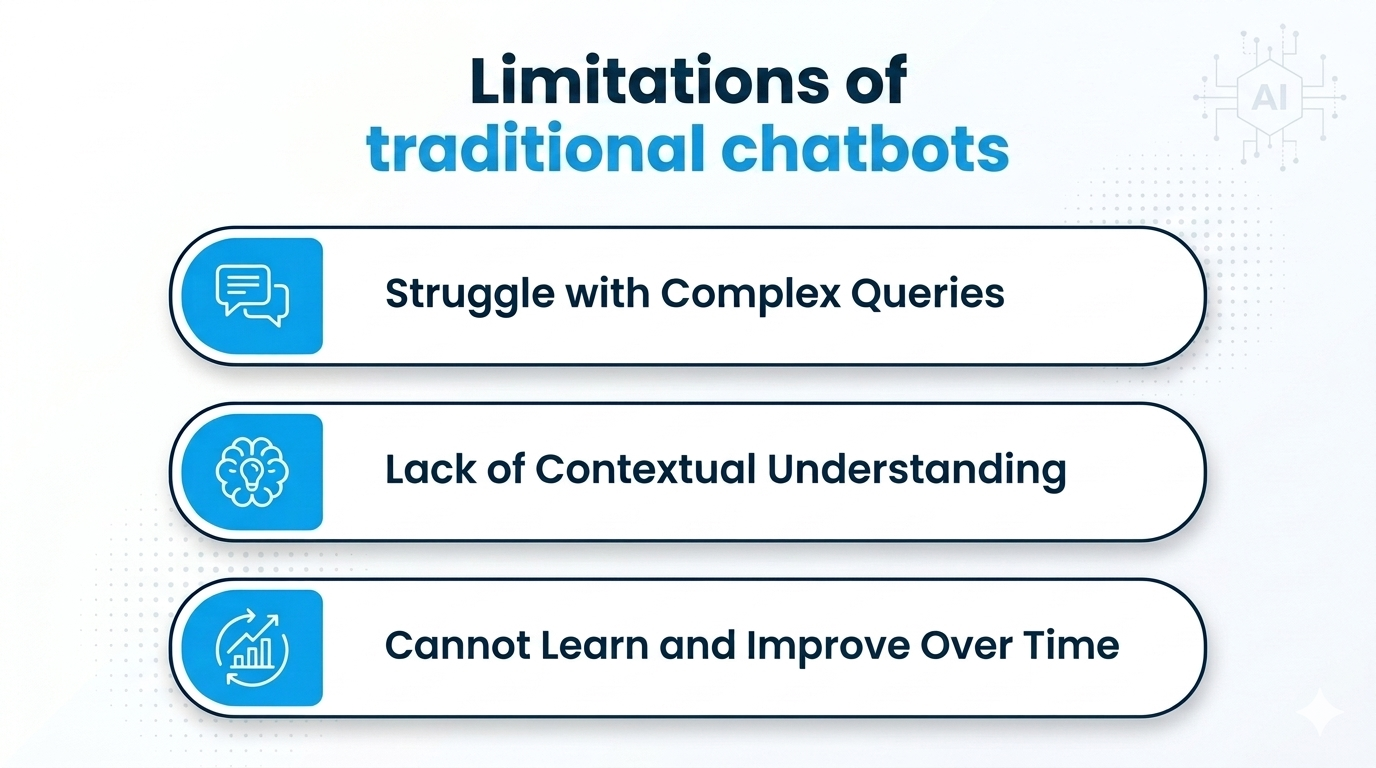
Lack of Contextual Understanding
Prior conversation history is not relevant. A customer who describes a problem in exchange one must restate it in exchange three. This stateless architecture generates friction at every step of complex interactions and is among the most cited drivers of chatbot dissatisfaction.
Dependence on Scripted Responses
Script libraries must anticipate every possible query variant. In practice, they cannot. Product portfolios expand. Rules change. Customer language changes. Each of these changes needs a human update of the chatbot's decision tree, leading to a content maintenance load that increases without corresponding improvement in resolution quality.
Bad Management of Complex Queries
Multi-variable queries — account eligibility, regional policy application, and conditional product terms — are not in the resolution scope of rule-based systems. Traditional chatbots either provide a partial answer which adds to confusion or pass the conversation to a human agent, defeating the purpose of efficiency altogether.
Limited Personalisation
Rule-based chatbots apply uniform responses regardless of customer profile, purchase history, or expressed preference. Systems that cannot adapt to the individual user are structurally misaligned with the interaction standards customers now consider standard.
Failure in Multilingual Conversations
Most chatbot platforms were designed for single-language environments. Multilingual support, where retrofitting through translation APIs occurs, lacks domain precision and cultural calibration. A literal translation of financial or healthcare terminology across regional languages introduces ambiguity, and in regulated sectors, uncertainty constitutes compliance exposure. Language AI Platforms, which approach multilingual capability as infrastructure rather than as translation, represent a materially different architecture for organisations serving linguistically diverse populations.
Weak Voice Interaction Capabilities
Voice is an increasingly dominant channel in markets where typing is inconvenient, connectivity is variable, or digital literacy is uneven. Traditional chatbot platforms offer no native voice capability. Integration with basic speech recognition introduces additional failure points without delivering coherent, multi-turn voice conversations.
Changing Customer Experience in 2026
Demand for Human-First Conversations
Generative AI's interfaces have set a new standard for what people expect from automated solutions. Scripted, non-adaptive responses are now immediately identifiable as inadequate, and the tolerance for them has declined accordingly. Customers expect systems that understand intent, not just keyword proximity.
Need for Faster Resolution
First-contact resolution rate is among the most consequential metrics in customer service operations. According to Gartner, organisations that fail to invest in conversational AI will face mounting competitive disadvantages as AI-capable peers establish higher-resolution benchmarks across digital channels.
Expectations Around Omnichannel Support
Customers expect continuity across channels. A conversation initiated on a web interface should carry forward into a mobile or voice interaction without requiring the customer to reintroduce themselves. Traditional chatbots are channel-specific and stateless by design — omnichannel continuity is architecturally unavailable to them.
Business Challenges Caused by Traditional Chatbots
High Escalation to Human Agents
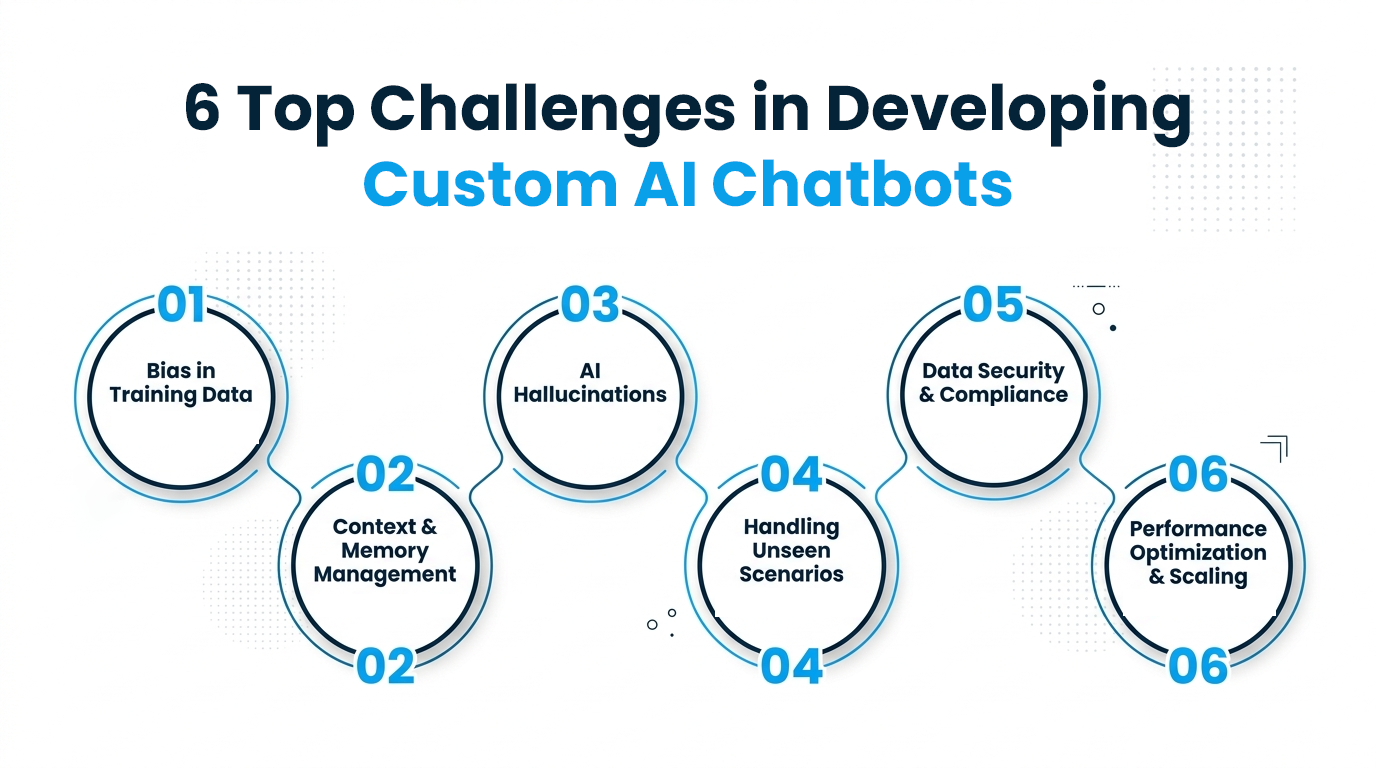
Escalation rate is the most direct indicator of chatbot system failure. When a system cannot resolve queries, interactions route to human agents, negating the cost efficiency that justified the initial deployment. This is not a configuration problem. It is a structural consequence of rule-based systems encountering query complexity they were not designed to handle.
Low Customer Satisfaction
McKinsey research demonstrates that organisations deploying generative AI within customer engagement functions report materially improved CSAT outcomes compared to those using rule-based automation. The performance differential reflects architectural depth, not deployment maturity.
Difficulty in Scaling Across Regions
Scaling a typical chatbot to other languages, locations or product lines takes individual configuration effort for each variable. The model does not scale inherently — it scales only through proportional manual effort. For enterprises expanding into regional markets, this approach represents a structural constraint on growth velocity.
Increased Maintenance and Training Costs
Many organisations find that chatbot maintenance costs erode the efficiency gains that justified the initial deployment. As operational complexity increases, the cost of keeping scripted flows current grows in direct proportion, without producing any improvement in resolution capability.
How Generative AI Is Replacing Traditional Chatbots
Context-Aware Conversations
Generative AI maintains conversational context across multiple turns. It understands user intent in the context of the complete interaction history, not just the current message. This allows for consistent multi-turn resolution without having the user to reiterate their circumstance.
Real-time Language Comprehension
Large language models understand natural language better than any pattern-matching system. They can handle unfinished sentences and domain-specific terminology all in one inference.
Voice and Multi-Language Support
Advanced conversational AI combines automatic speech recognition, natural language processing and text to speech synthesis in one interaction paradigm. For organisations serving multilingual populations across India, Devnagri AI's sovereign language infrastructure demonstrates how domain-calibrated multilingual and voice capabilities can be embedded directly into regulated enterprise workflows, handling regional dialects with an accuracy that generic translation layers cannot achieve.
Continuous Learning and Adaptation
Unlike static rule libraries, generative AI systems can be fine-tuned on domain-specific interaction data, improving resolution quality in proportion to operational scale rather than in opposition to it.
Traditional Chatbots vs Conversational AI Assistants
Rule-Based vs Generative AI
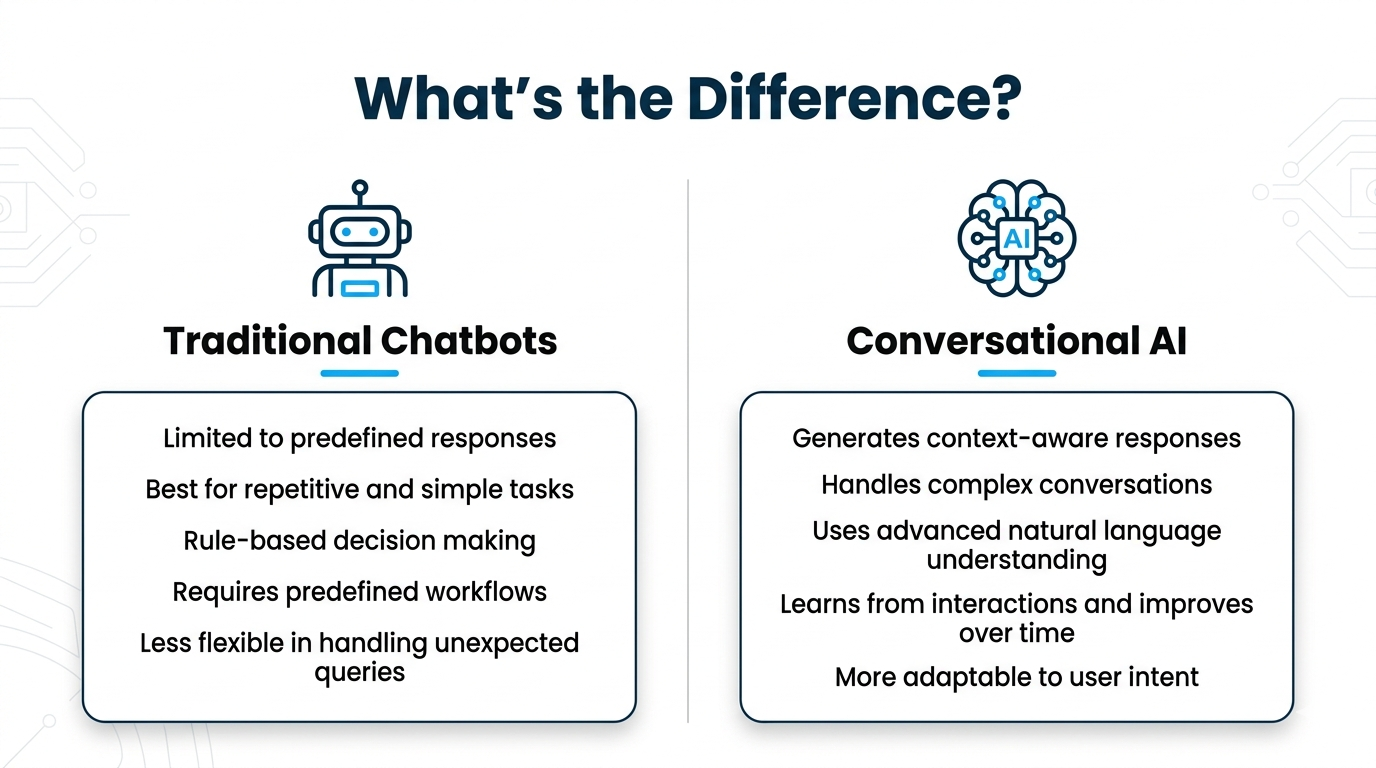
Rule-based chatbots execute predetermined logic. Generative AI is aware of its purpose and generates contextually relevant replies in real time. This is a categorical design difference, not an incremental capability difference.
Static Flows vs Dynamic Conversations
Decision trees define every possible interaction path in advance. Conversational AI navigates ambiguity, manages contextual shifts, and supports non-linear conversations — which is the structure that characterises virtually all complex customer interactions in practice.
Limited Support vs End-to-End Assistance
Traditional chatbots handle narrow, transactional queries within a single session. Conversational AI manages end-to-end customer journeys, from initial enquiry through complaint resolution and post-transaction follow-up, within a coherent, persistent interaction model.
Industries Where Traditional Chatbots Are Failing Fast
Banking and Financial Services
BFSI consumers often have multi-variable questions about account status, product eligibility, regulatory disclosures and complaint processing. Rule-based chatbots cannot handle this complexity or comply with compliance norms regulating financial communication. Research from the IBM Institute for Business Value finds financial institutions that have deployed AI-powered virtual assistants have greater resolution rates and lower per-interaction costs than those using scripted systems.
Ecommerce and Retail
Purchase journeys require product discovery, contextual recommendation, order management, and post-purchase support. These are dynamic, multi-step interactions. Traditional chatbots have no architectural capacity to deliver them coherently.
Government Services
Citizen-facing services require multilingual accessibility, procedural accuracy, and sensitive handling of eligibility enquiries. Rule-based systems in India's public service delivery face structural gaps due to the typical linguistic diversity and query complexity, which undermines both citizen experience and operational efficiency.
What Businesses Should Look for in Modern Conversational AI
Multilingual Features
Judge platforms by the depth of the multilingual architecture they've built, not by the number of languages they support. The operative performance indicators include domain-calibrated accuracy, regional dialect management and cultural tone control.
Voice AI Integration
Find out if voice processing is hardwired in the core or attached to a text-based base. The operational baseline for enterprise adoption in 2026 is end-to-end voice AI with ASR, NLP and TTS in a coherent interaction paradigm.
Enterprise Security & Compliance
Governance-grade deployments require zero data retention options, immutable audit logs, and flexible deployment across SaaS, VPC, and on-premises environments. For regulated sectors these are procurement requirements, not optional features.
CRM & Workflow Integration
Conversational AI needs to connect with existing enterprise systems. Assess the level of connection with CRM systems, core banking systems, call centre technologies and mobile applications before committing to deployment.
The Future of Conversational AI Beyond Chatbots
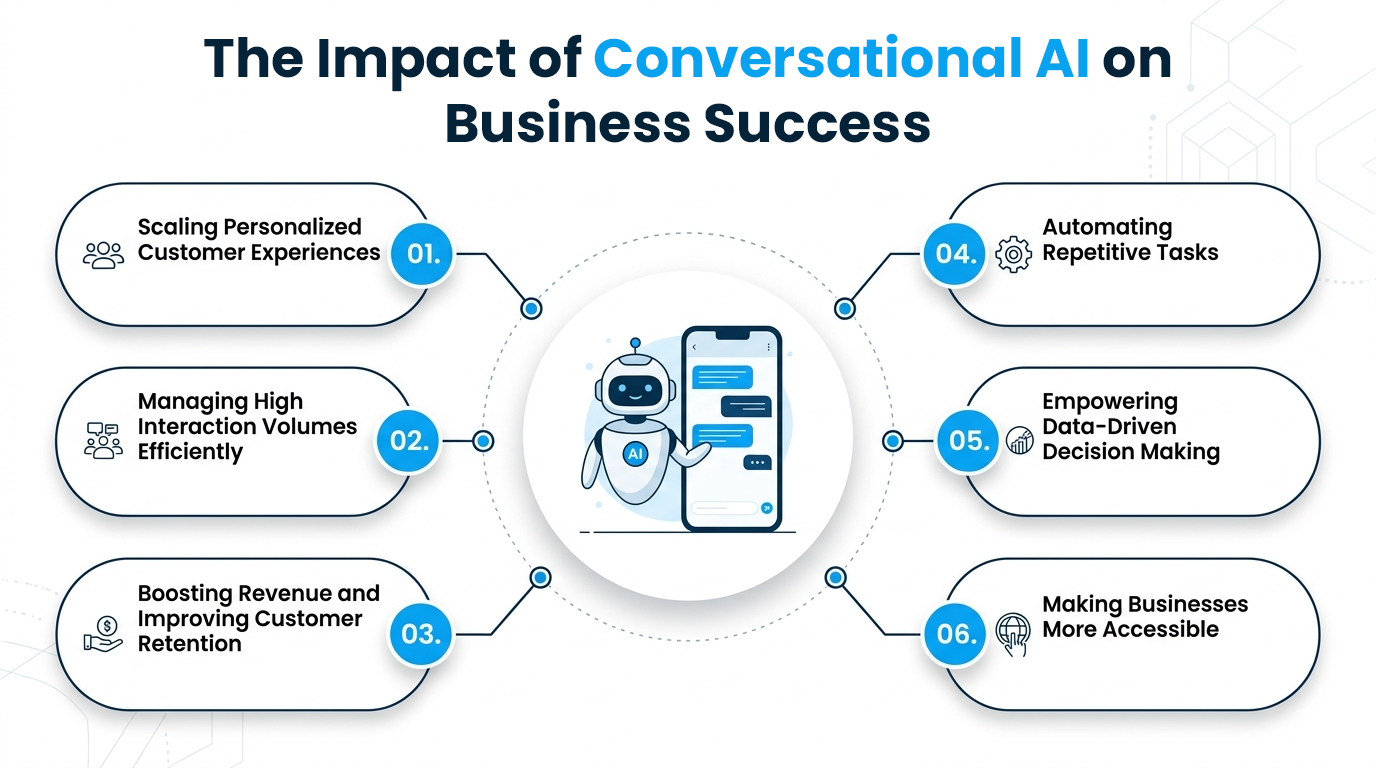
The near-term trajectory of conversational AI points toward agentic systems: platforms that execute multi-step workflows autonomously, integrate real-time enterprise data, maintain persistent memory across sessions, and adapt to individual user context without human intervention. The chatbot, as a discrete interface, is being absorbed into broader AI orchestration layers that span customer engagement, back-office processing, and regulatory compliance functions simultaneously.
Organisations framing their AI investment around chatbot replacement are addressing a tactical problem. A compounding operational capability is being built by those who frame it around conversational AI infrastructure.
Conclusion
Traditional chatbots have reached the boundary of what their architecture can sustain. The complexity of customer queries, the diversity of channels and languages, the precision of regulatory requirements, and the sophistication of customer expectations have collectively exceeded the functional ceiling of rule-based systems.
The transition to modern conversational AI is not a technology refresh — it is an operational architecture decision with direct implications for customer experience quality, cost structure, and regional scalability. Organisations that delay this transition are not maintaining the status quo. They are accepting a widening performance gap against competitors who are not.