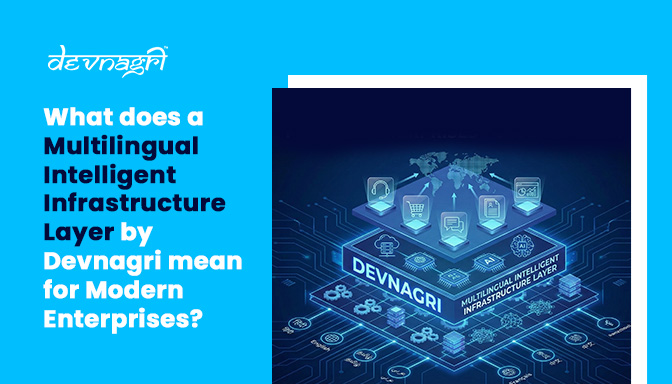
Multilingual capability rarely starts as a strategic priority. In most organizations, it shows up quietly. A document needs to be translated for a regulator. A customer email needs to go out in another language. A regional team asks for local content. Over time, these requests add up.
What many enterprises now realize is that language is no longer confined to a single function. It touches onboarding, compliance checks, customer communication, internal documentation, and voice interactions, often at the same time. What once felt manageable as document translation has gradually become a dependency that cuts across systems and teams.
As this dependency grew, traditional translation models, as compared to AI-powered translation services, began to feel strained. They were designed for individual tasks, not for environments where the duplicate content, meaning, or intent needs to travel across workflows. The response, in many cases, has not been to add more tools or vendors, but to rethink how language is handled altogether. This is where the idea of a Multilingual Intelligent Infrastructure Layer, or MIIL, begins to take shape.
How Language Became Operationally Central
Most organizations did not "decide" to become multilingual. It happened incrementally. A compliance document was translated. Then a regional campaign followed. Customer support started receiving queries in local languages. Voice channels expanded, bringing with them variations in accents, expressions, and code-mixed speech.
What changed in recent years was not the presence of language, but how deeply it entered daily operations. Language affected delivery times in website translation platform and app translation services, audit results, and customer trust. Document translation included scanned PDFs, handwritten forms, and mixed-language submissions. Real discussions, often poorly recorded, replaced rehearsed calls.
This transition, coupled with increased regulatory monitoring and consistency demands. Gartner reports that data and process quality concerns, particularly language discrepancies, continue to cause scale-related inefficiencies and risk. Many companies made language a priority for operational reliability.
Where Traditional Document Translation Platforms Fall Short
Traditional translation procedures are task-based. Content is developed, translated, vetted, and distributed. This works for controllable volumes and constrained circumstances.
At scale, the cracks are less obvious but more persistent. A document translated for compliance by document translation platform may not fully align with how the same information is presented to customers. OCR outputs from scanned forms follow separate handling. Voice transcripts sit in their own systems. Over time, coordination overhead grows.
Teams compensate by adding checks and manual steps. Costs increase, but the more significant impact is on speed and confidence. The organization becomes dependent on translation without having a shared system to manage how language behaves across workflows.
McKinsey has observed similar transitions in other enterprise localization solutions, where tools that worked well in isolation eventually required platform-level thinking to remain dependable (Source).
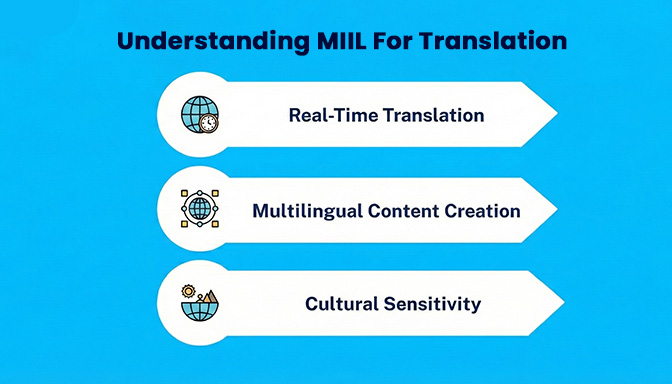
Language as a Shared System
As language touched more workflows, enterprises began to notice a structural issue. Multiple teams were relying on the same linguistic outputs, but those outputs were being generated independently.
The questions leaders asked started to change. Speed mattered, but consistency mattered more. Coverage mattered, but governance mattered alongside it. This pattern is not unique to language. Identity, payments, and analytics followed similar paths as they moved from edge functions into shared systems embedded across operations.
Defining a Multilingual Intelligent Infrastructure Layer
A Multilingual Intelligent Infrastructure Layer is a persistent system that allows language to operate across enterprise localization solutions in a coordinated way.
Instead of treating translation, OCR, transcription, or dubbing as separate services, MIIL integrates these capabilities into existing systems. It supports text, documents, voice, and media while maintaining shared context, domain rules, compliance requirements, and intent.
MIIL emphasizes real-world inputs. This includes scanned papers, handwritten writing, regional language blending, and spoken variations. Automation and organizational language decision reuse and governance are the intelligence.
MIIL and Point Solutions
Point solutions solve specific problems. A document is translated. A call is transcribed. A video is subtitled. Each task may be completed effectively, but independently.
MIIL operates differently. It focuses on continuity. Language outputs generated in one context align with those used elsewhere. Governance applies consistently. Updates do not need to be reintroduced in multiple places.
This difference becomes clear when workflows intersect. A customer onboarding document processed through OCR feeds into compliance review, customer communication, and support. In a point-solution setup, each step reinterprets language. In an infrastructure-oriented setup, language understanding flows through the journey.
Enterprise Journeys Enabled by MIIL
In onboarding, customer communication, content operations, and voice support, MIIL reduces repetition and rework. Once processed, documents retain significance, and outputs move across systems with fewer manual interventions. Although less obvious than feature launches, these improvements compound over time.
Why the Indian Context Amplifies the Need?
India's linguistic complexity is often described in numbers, but the reality is more nuanced. Spoken and written forms differ. Code-mixing is common. Regulatory documentation must align with how customers actually read and listen.
The World Economic Forum has noted that AI translation platforms must adapt to regional linguistic realities to remain reliable and inclusive ( Source). In such environments, fragmented language handling increases risk. Infrastructure-level approaches offer a way to manage complexity without slowing operations.
Implementation Considerations: What MIIL Looks Like in Practice
Enterprises rarely adopt an enterprise translation platform powered by Multilingual Intelligent Infrastructure Layer through a single, well-defined program. It usually starts with a narrow problem that refuses to stay narrow.
Document translation is a common entry point. A team tries to speed up the processing of scanned forms or multilingual PDFs. That effort works for a while, until the same documents begin feeding compliance checks, customer communication, and downstream analytics. At that stage, translation accuracy is no longer the main issue. Consistency and reuse become more complicated to manage.
When organizations pause to map these flows end to end, they often notice something uncomfortable. Language-related decisions are being made multiple times, by different teams, using slightly different assumptions. Over time, those differences turn into delays, rework, and audit questions that are difficult to trace back to a single cause.
In practice, MIIL implementations tend to evolve around a few recurring realities:
Language enters earlier than expected
It shows up at the point of data intake, uploaded documents, forms, or customer messages, not at the final communication stage.
Rules already exist, just not centrally
Teams have informal glossaries, preferred phrasing, and compliance interpretations scattered across documents and systems.
Human review cannot scale evenly
Reviewing everything slows the business. Reviewing nothing increases risk. Most enterprises eventually move to selective, risk-based oversight.
Integration matters more than elegance
Even strong language models create friction if outputs still require manual movement into KYC systems, CRMs, or case-management tools.
Another lesson appears over time. MIIL works best when treated as something that can change. New languages are added. Formats evolve. Regulatory expectations shift. Organizations that expect stability tend to hard-code decisions too early, then struggle to adapt.
Those that treat multilingual capability as an evolving layer, adjusted quietly as the business grows, tend to experience fewer operational shocks. Language stops being a recurring project and becomes part of how systems are expected to behave.
Opportunities, Risks, and Considerations
The primary opportunity of MIIL lies in consistency and reuse. Enterprises can scale document translation and multilingual workflows without proportional increases in effort.
Risks are architectural. Unintegrated or ambiguous ownership might produce higher-level silos. Over time, leaders evaluate MIIL based on integration depth, governance, and adaptability. These factors move the focus from per-document expense to long-term capability.
Note on Devnagri
Indian platforms like Devnagri use language AI, localization automation, and infrastructure-level integration. The focus on real-world data and controlled workflows matches how MIIL is becoming understood in practice.
Conclusion
Most enterprises do not redesign how they handle language all at once. The shift toward multilingual infrastructure usually happens in response to operational pressure. As organizations scale across regions and channels, language begins to behave less like a one-time requirement and more like a shared system. When that system is designed thoughtfully, language becomes easier to manage, not because it disappears, but because it fits naturally into how the business operates.
FAQs
Why use a Multilingual Intelligent Infrastructure Layer?
Multilingual Intelligent Infrastructure Layer manages complexity across workflows, not just translation.
How much is the Multilingual Intelligent Infrastructure Layer?
Scope, integration depth, and long-term operational efficiency determine costs.
How is MIIL different from other solutions?
Most solutions address individual language tasks. MIIL coordinates language capabilities across systems and teams.