Get Summary




Voice Bots vs Chatbots: Choosing the Right AI Assistant
A voice bot and a chatbot solve the same basic problem, automating a conversation, but they do it through two entirely different channels. One listens and talks back. The other reads what you type and answers in kind. That's really the whole distinction, and yet it shapes almost everything else about how each one gets built, what it costs, and when a customer will actually reach for it.
So if you're a business trying to figure out where to put your first dollar, don't ask which technology is better. Ask which channel matches how your customers already behave. In most cases, the honest answer is that you'll need both eventually.
What Is a Voice Bot?
A voice bot handles conversations through spoken language instead of text. Someone talks, and automatic speech recognition (ASR) turns that speech into words on a page, so to speak. From there, a natural language understanding (NLU) layer figures out what the person actually wants, and text-to-speech (TTS) turns the response back into something the caller hears, ideally fast enough that it doesn't feel like talking to a machine with a lag problem.
This process is also where "AI voice assistant" comes into the conversation. Siri and Alexa run on essentially the same pipeline; speech goes in, intent gets understood, and speech comes back out, just aimed at things like setting a timer instead of running a business process. On the enterprise side, a voice bot does that same job for phone calls: picking up a support line, walking someone through a loan application, working a collections call, and doing it without a human agent unless things get complicated enough to need one.
Speech is messy in ways text isn't. Accents, background noise, people talking over the bot mid-sentence, all of that has to get handled somehow. Which is part of why voice bots tend to need heavier models than their text counterparts and why they usually cost more to build and keep running well.
What Is a Chatbot?
A chatbot skips the speech altogether and works in text, usually sitting on a website, inside an app, or on something like WhatsApp. Natural language processing does the heavy lifting of figuring out what a typed message means, and the response comes either from a workflow someone designed ahead of time or, more and more often now, from a generative model that can carry a looser, more open conversation.
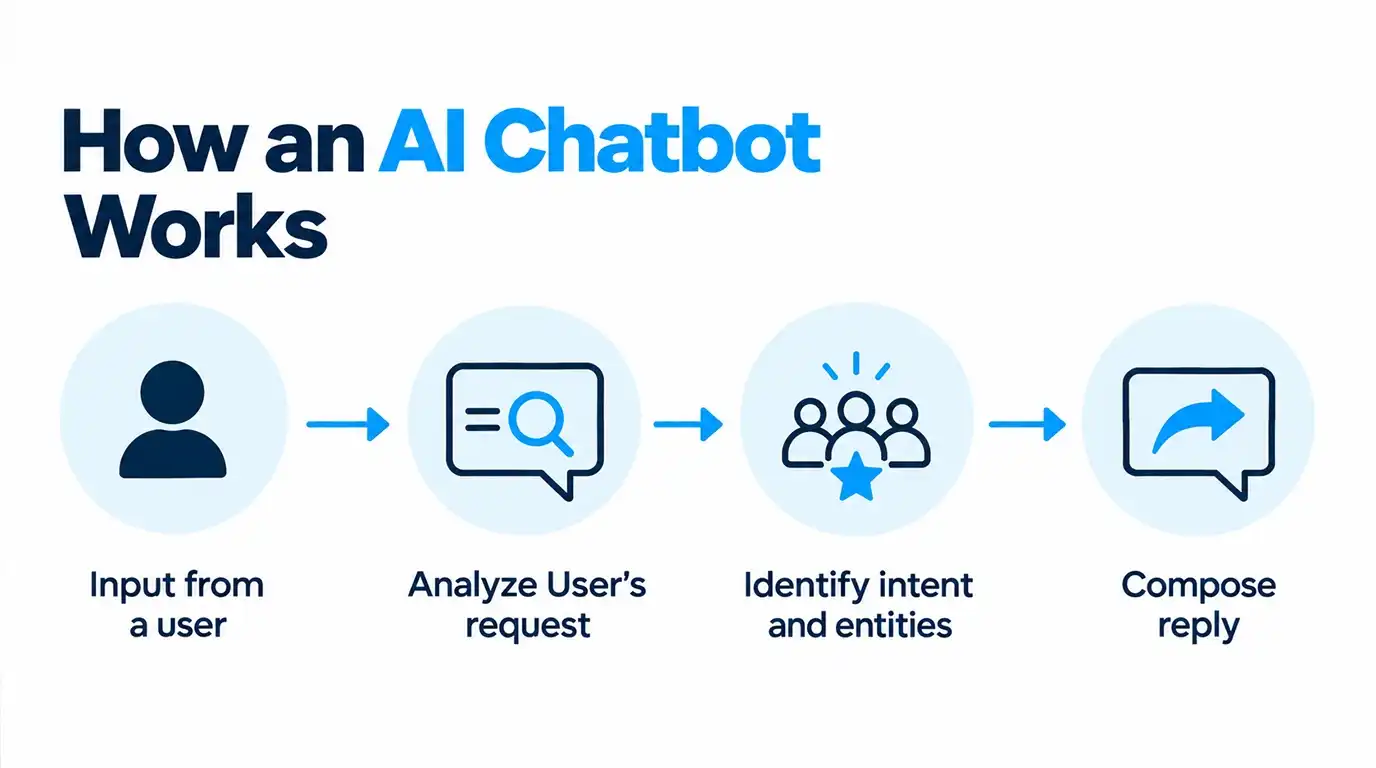
Building one is generally quicker and cheaper than building a voice bot, mostly because there's no speech recognition or synthesis to get right. There's also a flexibility to text that voice doesn't really have. A customer can start a chat, get distracted, walk away, and pick it back up an hour later without losing anything. Try doing that on a phone call.
Key Differences & When to Use Each
Aspect | Voice Bot | Chatbot |
|---|---|---|
Channel | Phone calls, voice-enabled devices | Website, app, messaging platforms |
Interaction style | Real-time, spoken, hands-free | Text-based, can be asynchronous |
Core technology | ASR, NLU, TTS | NLP, workflow, or generative AI |
Build complexity | Higher must handle accents and speech variation. | Lower text input is more predictable. |
Best for | Urgent, hands-free, high-emotion interactions | FAQs, self-service, multitasking-friendly queries |
Typical cost | Higher to build and maintain | Lower to deploy and scale |
In practice, the decision usually depends more on context than on anyone's stated preference. Someone tracking a delivery while stirring dinner on the stove is going to call, not type. That same person comparing two loan products is probably going to want to sit with the details in a chat window, maybe scroll back up and reread a line, rather than hear it once over the phone and hope it sticks. Urgency, whatever else the person is doing with their hands, and how complicated the information is, are the factors that actually influence the decision.
Industry Examples
BFSI
Collections calls and loan servicing tend to work better as voice bots. There's an urgency to them, and a real back-and-forth helps. But something like a balance check or a document status update doesn't need a phone call at all. A chatbot on WhatsApp or the website handles that just fine.
Insurance
When someone's filing a claim, they usually want to call, especially if the situation feels stressful or time-sensitive. A voice bot can take down the claim details and route the case right away. Renewal reminders and general policy questions, though, don't carry that same urgency, and a chatbot does the job for a fraction of the cost.
E-commerce and D2C
Order tracking and basic product questions fit naturally into a chatbot, since the customer's already on their phone or laptop anyway. Voice bots show up more on the outbound side, things like confirming a cash-on-delivery order or nudging someone about an abandoned cart.
Government Services
A lot of citizens looking for scheme information still reach for the phone, particularly in places where digital access or comfort with apps isn't a given. A chatbot on a government portal serves the people who are already online and would rather read through the details themselves.
How Devnagri Supports Both
Instead of building voice and chat as two separate products running on two separate backends, Devnagri runs its Voice Bot and AI Chatbots off the same underlying language layer. That means both channels read intent, tone, and regional language the same way. A customer who starts in Hindi on the chatbot and calls in a week later gets a voice bot that sounds and responds with that same cultural calibration, not some jarring switch in how the system talks.
That consistency matters more here than it would in most global markets, since a single customer base in India can span several languages and channel habits depending on age, location, and how comfortable someone is with digital tools in general. Building voice and chat on shared infrastructure, rather than duct-taping together two unrelated vendors, keeps things consistent no matter which channel a customer happens to pick that day.
Conclusion
Voice bots and chatbots aren't really competing for the same job. They're built for different moments in a customer's day, one for real-time, hands-free conversations, the other for the kind of self-paced exchange you can walk away from and come back to. Most businesses don't choose one over the other. They end up needing both, ideally with both running on infrastructure that keeps the experience from feeling disjointed, no matter which one the customer reaches for.