Artificial intelligence certainly allows incredible personalization in customer experience (CX) and customer communication. It enables personalization through data analysis-generated targeted offers. At basic stages of functionality, chatbots give messages and push notifications based on prompts received, using a preconfigured decision tree rooted in the database.
Today’s technology offers great promise, but it is just the beginning of what AI will accomplish in the future of personalized customer experience. The global customer support market will be valued at $10.19 billion in 2023 and reach $61.69 billion by 2032 .
We are at the very early stages of what AI can do to change how businesses contact their consumers. Today, AI goes far beyond simple chatbots to encompass Natural Language Processing (NLP) technology, which allows the comprehension of customer intent and sentiment in industrial applications like banking finance translation, media translation, eLearning translation, etc. To this end, AI systems understand contexts, offer emotion differential analyses, and give appropriate responses across many languages. In the same direction, the multilingual localization aspect automates tools with translation memory that houses vocabulary and other materials, all from data generated through machine learning.
Current State of AI in Customer Communication
Basic segmentation:
AI divides customers according to demographic data, purchase history, and behavior patterns. Thus, Salesforce notes that 76% of customers expect companies to understand their needs. However, segmentation is still pretty basic today, as most AI models rely on simple filters like age, sex, locality, or past purchases to deliver personalized experiences.
Chatbots and Virtual Assistants
A study certifies that about 1.5 million people have spoken to chatbots at least once in the last year. However, most current systems are still more product-oriented than customer-oriented, which inhibits their ability to handle open-ended questions and specific customer needs.
Focused Email Campaigns:
Current AI applications in email marketing sound very promising but still need improvement. Personalized email campaigns that use customer browsing and purchase history to create targeted content, dynamic visuals, and content, but see only a 29% open rate due to a lack of the most advanced personalization customers increasingly expect.
Detection of sentiments:
AI systems today can only recognize fundamental customer sentiment from feedback and generate appropriate responses. However, the most common frustration comes from predetermined response options, which frustrates 71% of customers who are unhappy with impersonal shopping experiences.
Limitations of Current AI Solutions:
– Unable to deal with complicated multi-step customer interactions.
– Apart from defined parameters, the context is not understood.
– Only essential personalization does not measure up to what customers expect.
– Respond inflexibly to frustrated customers who demand nuanced assistance in their language.
The Future of Customer Communication with AI

As we distance ourselves from the present-day barriers, AI-powered machine translation APIs will redefine customer communication through a much richer and more sophisticated capacity for personalization and interaction. Thus, in the future, customer communication will feature much deeper personalization, including context awareness in real-time, behavioral prediction, and even anticipated emotional engagement. By creating customer interactions across touchpoints would offer a much greater brand image and hyper-relevance.
Advanced Data Intelligence. Today’s systems focus more on data collecting, but in the future, the best AI technologies will build complex analysis and prediction into systems:
- Integration of social media interactions, browsing patterns, and purchase history.
- Analyze emotional nuances in verbal and written communication.
- Process multiple languages and geographic accents almost human-like.
- Predict customer needs with tremendous precision in behavior.
Read Also- Creating Content Only in English? Here’s What You’re Missing Out
Only one in six businesses currently offer multilingual customer service. Thus, a tremendous opportunity exists to enhance globalized market applications and customer satisfaction by implementing advanced AI-powered translated and conversational systems. Hyper-personalized CX by Future AI platforms will foster truly personalized customer relationships. It’s all done through real-time dynamic content engineered to transform customer interaction into truly synergized, contextually relevant experiences. All this is done while understanding and responding to the sentences and the emotions behind them. It will feel as if no contact is standard but personalized for every customer.
The next generation of chatbots and voice assistants will revolutionize customer interaction with advanced natural language processing and emotional intelligence. They will allow mainly context-aware conversations and, above all, switch languages and adapt to regional accents seamlessly, making the interaction more natural and effective.
Examples include AI becoming proactive and advancing from simply reactive by forecasting when an issue will arise. The customer will receive personalized recommendations from these systems at their optimal time—the most comprehensive predictive modelling to develop a relationship between a business and its customers.
Future AI systems can convey a message to consumers through different channels while optimizing each channel in its respective way. Thus, they would create a fully synchronized real-time journey for a particular person with the organization from customer points of entry, ultimately creating a completely integrated path.
That evolution of customer communications through AI systems will increase satisfaction and build deeper relationships between brands and their customers. Companies using this advanced AI clout will be far ahead in a hyper competitive digital marketplace.
Read Also- A 5-Step Plan for Global Market Entry Using AI-powered Machine Translation
How do modern AI conversational bots handle multiple languages?
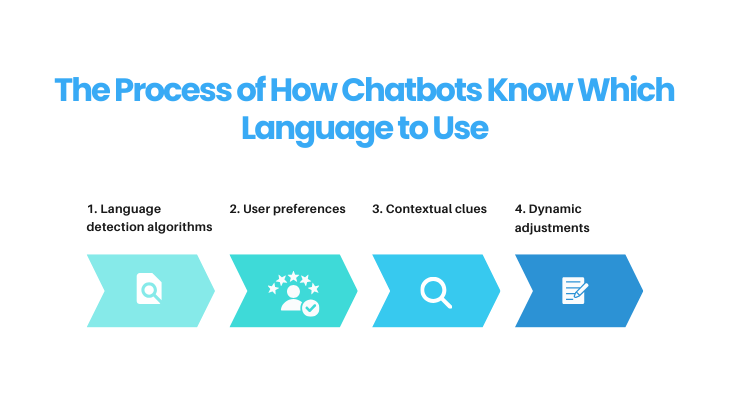
Multilingual Conversational AI Bot use language detection algorithms, which are trained on highly advanced machine learning and artificial intelligence technology powered by generative AI to respond the same way a customer asks for something, whether it is out of the translation memory. Modern bots can determine the language based on linguistic patterns, syntax, and word usage. Additionally, third-party libraries or machine translation APIs. It works on contextual clues and can analyze metadata. Combining all such factors allows chatbots to effectively determine and adapt to the person’s preferred language, making interactions smoother and more engaging.
How are Multilingual Conversational Bots Multiplying ROI?
Market-specific localization multiplies customer trust in any business by incorporating multilingual conversational AI for localization. Localization creates an authentic native experience for audiences in specific regions instead of just translation. It mirrors the understanding of cultures and being thorough with marketing-specific needs. Customers can prefer to communicate in the language of their choice with increased probability:
- Engage meaningfully with the brand
- Complete purchases with confidence
- Develop long-term brand loyalty
- Share positive experiences within their community
Multilingual bots, like the Conversational AI Bot by Devnagri AI, can respond every time they receive a query in the language they use. Advanced language detection and response implementations in modern multilingual AI systems automatically detect and respond to the customer’s preferred language. Thus, traditional friction points such as language selection menus should be eliminated. This seamless experience is a massive jump from a manual language selection in traditional IVR to modern customer support not only talking as humans do but also thinking that way.
Besides improving CX, such multilingual AI-powered customer support systems also deliver tangible results.
Besides improving CX, such multilingual AI-powered customer support systems also deliver tangible results.
- Brighter customer satisfaction rates
- Higher conversion rates in newer markets
- Lowered support costs through the act of automation
- Broader coverage over global markets
- Increased customer retention in regional markets
The future of customer support is to have friction-free, naturalistic multilingual conversations in and across different regions using translation APIs. That way, it will scale for businesses to go global and still maintain personal connections with local markets. Contact us today for more information.