By 2026, mobile app translation will no longer be a “localization task.” It will be a core growth lever, as critical as pricing, onboarding, or performance optimization. Businesses expanding across India, Southeast Asia, Africa, and the Middle East are already learning this the hard way as English-first apps stall, while local-language apps scale.
This shift is not about adding more languages. It is about how language intersects with trust, adoption, and unit economics in mobile-first markets. Translation decisions now influence CAC, churn, support costs, and regulatory exposure.
This blog unpacks the do’s and don’ts and the real cost dynamics of mobile app translation in 2026, using consulting frameworks, real-world case studies, and grounded data. It is written for CXOs who want clarity, not jargon.
Industry Landscape
Two structural changes are colliding. First, mobile usage is fragmenting linguistically.More than 22 languages are spoken in India, with Hindi, Bengali, Telugu, Marathi, Tamil, and Malayalam growing rapidly outside Tier-1 cities. Malayalam is used in internet commerce, media, and education despite its small population. This makes English to Malayalam translation, and many other Indian languages like Kannada, Marathi, Hindi, Odia, etc., an essential step for businesses looking to cover the audience in the local markets.
Second, users now expect apps to speak their language by default. This is no longer a “nice to have.” According to the World Economic Forum, inclusive digital access, including language accessibility, is becoming a prerequisite for economic participation in emerging markets (Source)
The result? Mobile app translation is moving from the product backlog to the boardroom.
Why Translation Strategy Is Breaking Down in 2026
Many leadership teams still treat translation as a one-time project. That model is collapsing.
Three patterns explain why:
1. Apps update weekly. Languages don’t.
Product teams ship faster than localization workflows can keep up.
2. Generic translation tools flatten nuance
For Indian languages, tone, formality, and script are essential.
3. Costs are obvious.
Drop-offs, misclicks, and support tickets, not translation invoices.
McKinsey has frequently noted that digital customer experience friction builds quicker than physical ones, affecting growth and loyalty (Source). Language is friction, but bad communication costs.
Practical Framework: CX-Focused Translation
Based on HBR's decision-centric design philosophy, 2026 mobile app translation should be assessed across three layers:
1. Functional Accuracy
Does the translation convey the correct meaning? Most teams stop here. That’s a mistake.
2. Behavioral Clarity
Does the user know what to do next? In Malayalam, for instance, literal translations often lengthen CTAs, pushing key actions below the fold.
3. Emotional Trust
Does the language feel native, or “imported”? Trust drops sharply when financial, health, or legal apps sound machine-translated.
Harvard Business Review notes that trust is built through repeated, low-friction interactions, not grand brand gestures. Translation sits squarely inside that trust loop.
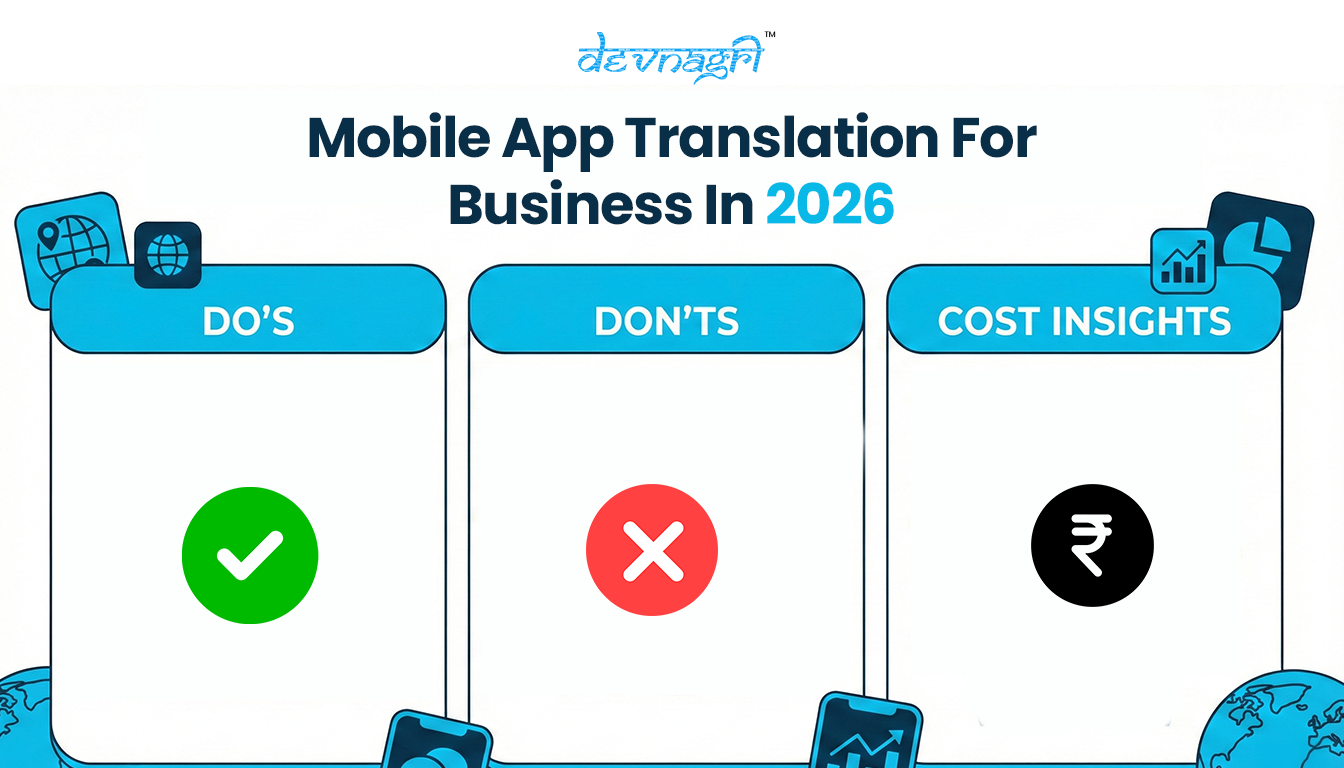
Do’s of Mobile App Translation in 2026
Do design translation as a system, not a task.
High-performing teams embed translation into CI/CD pipelines, not release checklists.
Do prioritize high-impact languages first.
“Most spoken language in India” does not always equal the highest ROI. Malayalam, Punjabi, or Kannada may outperform Hindi depending on the category.
Do combine AI scale with human context.
Pure automation breaks nuance. Pure human workflows don’t scale.
Do test translated UX, not just text.
Buttons, error states, and onboarding flows behave differently once translated.
Don’ts That Quietly Kill ROI
- Consumer translation apps aren’t built for products.They’re excellent at translating a sentence. They struggle with flows, edge cases, and what users actually do inside an app.
- Translation alone isn’t enough. How you present prices, dates, tone, and politeness can affect how trustworthy your product feels in different regions. Miss that, and users feel it instantly.
- The hidden cost shows up later. Translation isn’t the expensive part. Keeping content up to date as products evolve is where teams are usually caught off guard.
BCG has observed that companies scaling digital products in emerging markets often under-budget ongoing localization by 30–50%, leading to experiencing debt over time.
Cost Insights: What Translation Actually Costs
Let’s address the question leadership teams always ask.
How much does a 1000-word translation cost?
In 2026, market ranges typically look like this:
• Basic machine translation: Low upfront cost, high downstream risk
• Human-only professional translation: ₹1,500–₹4,000 per 1,000 words, slower turnaround
• AI-assisted, human-reviewed workflows: Mid-range cost, fastest ROI at scale
However, this question misses the point.
The actual cost variable is the update frequency. An app updated twice a month with five languages quickly turns translation into an operational cost centre unless automation is built in.
This is where language AI platforms, such as Devnagri, have quietly emerged. Not as translation vendors, but as infrastructure for continuous localization across Indian languages at scale, including complex scripts like Malayalam. When done right, they reduce rework, not just cost.
The Blind Spot in Mobile Translation
Many companies make mobile app translation decisions below the P&L owner. Product teams prioritize features. Marketing emphasizes acquisition. Language is operationally grey.
This creates a structural blind spot.
When translation quality drops, dashboards rarely reflect a “language issue”. It lowers conversion rates, delays onboarding, and raises support costs. Costly issues are noticed by the company.
In 2026, top teams weigh language choices by growth and risk, not content cleanliness. Because of its importance, translation is assessed as seriously as pricing tests or funnel optimization.
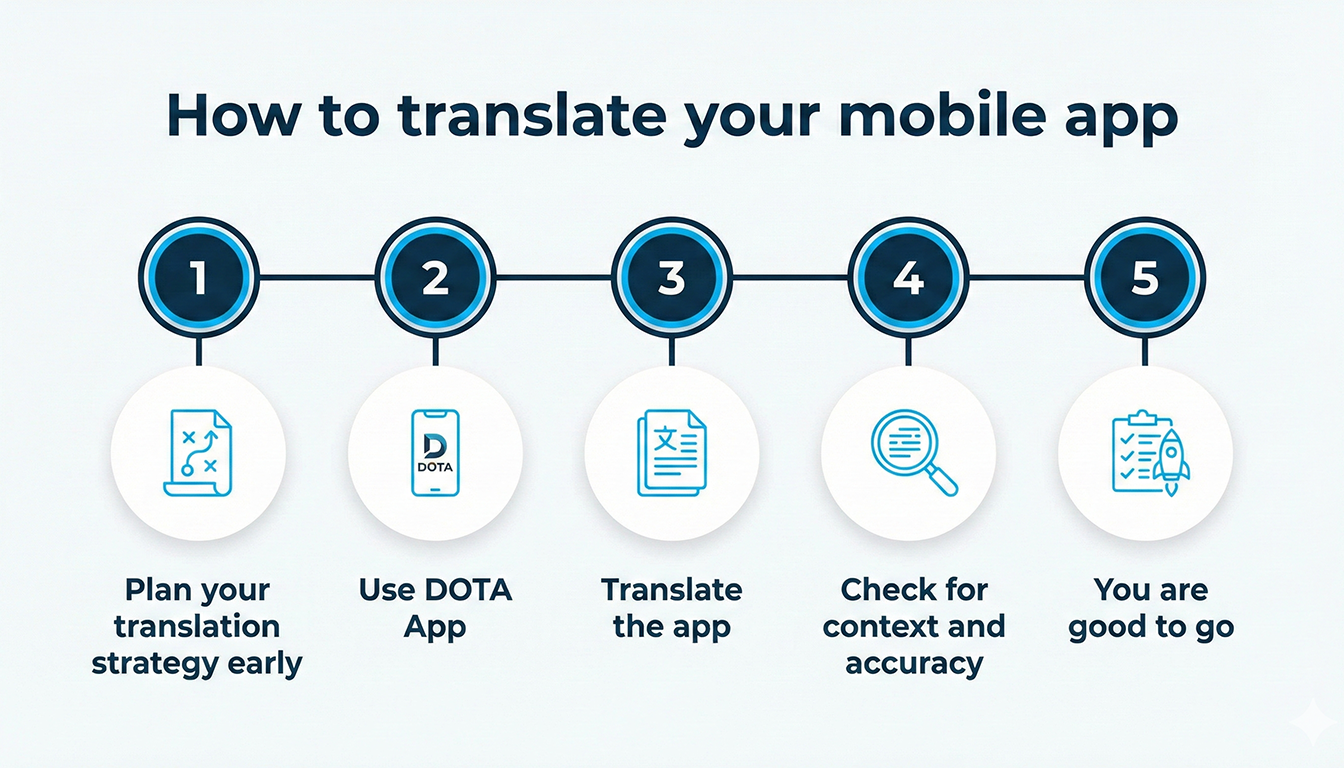
Launch app in minutes with Devnagri AI's DOTA App (Devnagri on the air) without altering core code or workflows. Use our APK, add language layers, and deploy. No long integrations. Independent of engineering sprints. It's a plug-and-play multilingual preparedness solution for fast-moving product teams that require instant Indian language reach without impeding releases.
Opportunities & Risks Ahead
For companies that get mobile app translation right, the upside is very real and surprisingly fast.
Strong localization shortens the distance between launch and adoption. Team starts are more consistent in regional marketplaces. Users move through onboarding with confidence instead of hesitation. Over time, this builds something far more valuable than installs: trust. And trust, in multilingual markets, tends to show up as higher lifetime value, lower support dependency, and fewer downstream compliance issues.
But the risks are just as real, and often self-inflicted.
One common mistake is over-automation. Fast translation systems inadvertently obscure critical flows without review or context. Another is fragmentation, different vendors handling app copy, support content, and compliance text, with no single source of truth. The result is inconsistency that users feel immediately, even if teams struggle to diagnose it internally.
The most considerable risk, however, is conceptual. Treating translation as “content” rather than infrastructure. When language is managed like copywriting rather than as a system that underpins product, trust, and governance, cracks appear as scale increases.
Gartner has cautioned that by the mid-2020s, poor localization will emerge as a leading cause of digital product failure in emerging markets, particularly in regulated environments where clarity and consistency are non-negotiable. The warning is not about language quality alone. It is about what happens when language is underestimated.
Conclusion
In 2026, mobile app translation is no longer about language. It is about respecting how users think, decide, and trust. The companies that win will not translate more.
They will translate better, faster, and continuously. As one consultant once put it during a late-night product review:
“Users forgive bugs. They don’t forgive being misunderstood.”
That truth has only become sharper with scale.
FAQs
Q: What does a 1000-word translation cost?
A: Language complexity, review depth, and update frequency matter. Expect broad fluctuations, but consider lifespan cost rather than per-word cost.
Q: What are the pros and cons of translation apps?
A: DOTA App handles context, tone, and regulatory nuances, making it well-suited for a multilingual market. Cons are none unless you opt for manual translation.
Q: How to translate a mobile app?
A: Use DOTA App to translate a mobile app in a single click.