A borrower missed three EMIs not because of cash flow stress but because a foreclosure notice arrived in English, and the collections script never registered that the customer responds better in Marathi. That single language gap turns a recoverable account into a write-off, and a service failure into a regulator's question.
Lending and housing finance institutions manage credit risk, market risk, and operational risk with dedicated frameworks. Language risk rarely gets the same treatment, even though it surfaces at nearly every borrower touchpoint, from onboarding disclosures to collections calls. This piece lays out what language risk management means across lending and mortgage, what a domain language model is and where it fits, and what governed borrower communication looks like across mortgage, lending, and housing finance for risk and collections leaders.
What Is Language Risk Management in Lending and Mortgage?
Language risk management is the discipline of identifying, measuring, and governing the points across a loan's life where a borrower may not have understood, in the language they actually use, what they agreed to. It belongs alongside credit risk, market risk, and operational risk, yet almost no institution tracks it as its own category today.
That gap matters because language failure rarely shows up labelled as 'language failure' inside existing data.
It shows up as a delinquent account that was really a confused borrower, a grievance ticket coded as a "service issue" that was actually a translation failure, or a recovery call that escalated because a regional dialect switch went unrecognised. Institutions serious about this risk should start by tagging language-related root causes inside their existing grievance, audit, and collections logs, the same way they would tag a fraud root cause.
What Is a Domain Language Model (DLM)?
A domain language model is the infrastructure that makes language risk management practical at scale. It is trained and calibrated on the vocabulary, structures, and regulatory register of a specific sector, not general internet text. In lending, a DLM understands the difference between a foreclosure notice and a pre-payment penalty clause and between a moratorium and a waiver and renders that distinction correctly in Hindi, Marathi, Tamil, or whichever regional language a borrower actually uses.
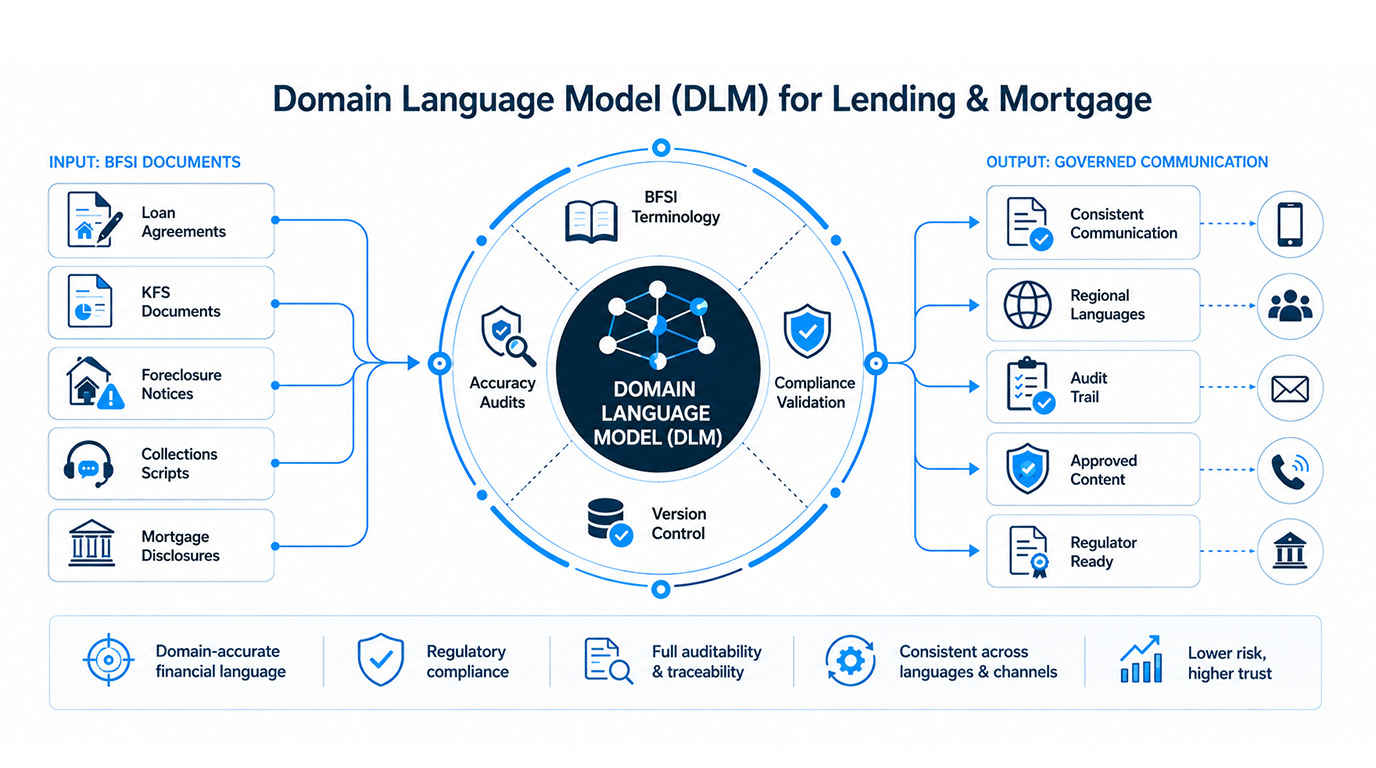
General-purpose multilingual AI tools are built for breadth, not domain precision; they can translate a sentence about EMI restructuring but cannot reliably hold its legal weight across edits and channels. For a chief risk officer evaluating a vendor, the right question isn't how many languages a model supports. It comes down to three checks.
Domain-Calibrated Terminology
The model should be calibrated on BFSI-specific vocabulary, not general internet text, so financial and legal terms hold their meaning across languages.
Accuracy Audits
Every model should be audited for accuracy specifically on financial and legal terms before it goes anywhere near a borrower.
Version Control
Every customer-facing line of text needs to trace back to an approved source, so an edit gets logged rather than silently overwritten.
Mortgage Customer Communication: Where Language Risk Concentrates
Mortgage communication concentrates language risk more than most other lending products because the loan tenure stretches across fifteen to twenty years and touches major life events: marriage, inheritance, resale, and foreclosure.
A single mistranslated clause in a sanction letter or a foreclosure notice does not just confuse a borrower. It creates a documented gap between what the lender disclosed and what the borrower actually understood.
Consider a foreclosure notice translated literally into a regional language. Depending on the term chosen, the literal rendering can read closer to property seizure than to early loan closure. A borrower who panics and stops responding to calls is now a collections problem the institution created through its own mortgage messaging, not through the borrower's behaviour. Housing finance companies should run a domain accuracy test on every mortgage document template before it goes live in a regional language, not after a complaint surfaces.
Lending Customer Communication and the Compliance Cost of Inconsistency
RBI's Fair Practices Code has required loan applications, sanction letters, and loan agreements to be issued in the vernacular language or a language the borrower understands since well before digital lending existed.
The Key Facts Statement mandate, applicable to all new retail and MSME term loans sanctioned from October 1, 2024, reinforces that same standard through a harmonized, standardized format across every regulated entity, including housing finance companies.
The compliance risk is not the requirement itself. It is inconsistent. A lender that handles regional-language sanction letters through one workflow, IVR scripts through a different vendor, and collections calls through a third has no single audit trail proving what was disclosed in which language on which date. When a grievance or an RBI Ombudsman complaint asks for that trail, fragmented systems cannot produce it cleanly. A governed workflow keeps every language version of every document inside one auditable system.
Housing Finance Customer Communication: Where the Exposure Concentrates
Housing finance companies carry a specific version of this risk. Loan tenures are longer, ticket sizes are larger, and a meaningful share of HFC borrowers in tier 2 and tier 3 towns transact more comfortably in a regional language than in English. Every touchpoint across that fifteen-to-twenty-year relationship, from the KFS at sanction to the NOC at closure, is a moment where a language gap can become a documented service failure.
An HFC that audits its loan lifecycle will often find a split.
Where Disclosure Already Works
Sanction documents and the KFS itself are typically available in regional languages, since these are the touchpoints regulators check first.
Where Servicing Quietly Defaults to English
Rate-reset notices, part-payment confirmations, and property release letters default back to English because no one built the regional-language version into that specific workflow. Housing finance lenders need a lifecycle map of this exposure, not a document-by-document fix.
Where Language Risk Hides in Operations
Collections Automation
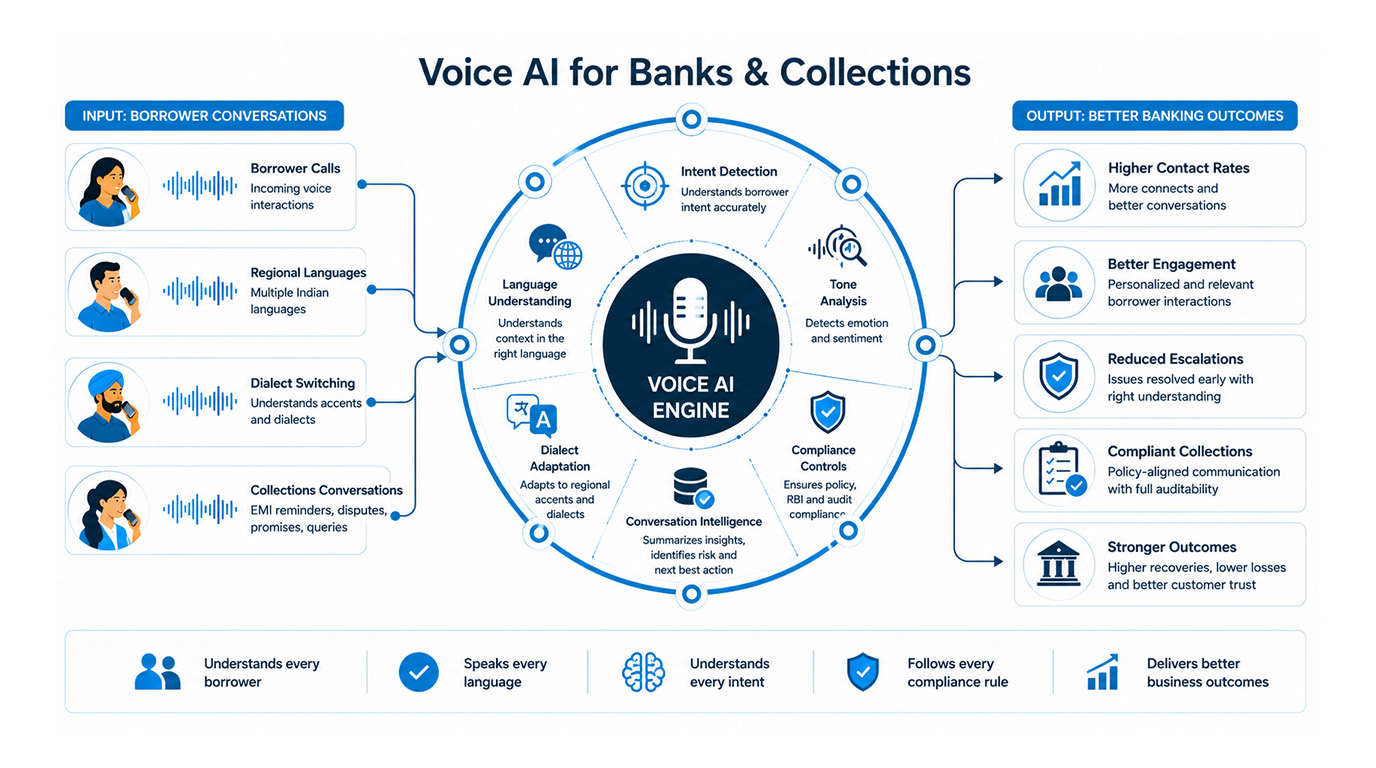
Collections teams under recovery pressure often add automation, predictive diallers, scripted outreach, and bulk SMS before they add language governance. An auto-translated script with the wrong tone can lead to violations of RBI's recovery agent conduct without anyone intending it. Devnagri's deployment data shows calibrated tone, soft, firm, or formal reminders layered onto regional-language scripts improve right-party contact and recovery response by 20 to 30 percent over generic, untoned outreach.
Voice AI for Banks
Most voice AI bots for banks are built and tested in English and Hindi, then extended to other languages later. That sequencing works backwards for distressed borrowers, calling about a missed EMI or a foreclosure notice, who are most comfortable in a regional language at exactly the moment they are most anxious. When a system cannot follow a mid-call dialect switch, the call escalates and the grievance log grows. Vendors should be asked for a live demo in distress-call scenarios, since that is where language failure shows up first.
What Language AI for BFSI Looks Like When It Is Governed
Language AI for BFSI earns trust through three structural commitments, not through breadth of language coverage alone.
Domain Calibration
Models trained specifically on BFSI vocabulary and tested against financial and legal terms before deployment are not adapted from general internet text after the fact.
Immutable Audit Trail
Every customer-facing message is logged by source, language, and version, allowing any regulator or internal auditor to reconstruct exactly what a borrower received.
Deployment Flexibility
Institutions with strict data residency requirements need the option to run this layer inside their own VPC or on-premise infrastructure, rather than send borrower data to an external API by default.
A risk or compliance leader assessing any language AI vendor should ask for evidence on all three points before asking about language count, as language count is the easiest claim to make and the hardest to govern.
A Framework for Language Risk Management Across Lending and Mortgage
Treat language as a risk category with its own audit, not a feature buried inside customer experience. A practical framework runs in four steps.
Map the Touchpoints
Map every borrower-facing touchpoint across the loan lifecycle, onboarding, servicing, collections, foreclosure, closure, and flag where English is the silent default.
Calibrate the Model
Calibrate a domain language model against your own document library, not a generic benchmark, so legal and financial terms hold their meaning across languages.
Route Through One System
Route every customer-facing message, voice, SMS, email, IVR, through one governed system with a single audit trail, rather than separate vendors for each channel.
Review in the Risk Committee
Review language risk in the same committee that reviews credit and operational risk, on the same cadence, with the same reporting discipline.
Institutions that run this framework report measurably fewer escalations and faster grievance closure because the gap between disclosure and understanding closes at the source instead of at the call center.
Conclusion
Language risk doesn't show up on a balance sheet, but it shows up in every metric that does: NPA ratios, grievance volumes, contact rates, regulatory findings. Treating it as a managed risk category, not a customer experience feature, is what lets a CRO, a CCO, and a Head of Collections answer one question with confidence: can we prove, for every borrower, in every language, that they understood what we told them?
Start by mapping where English is currently the silent default across your loan lifecycle. Download the BFSI Language Risk Brief to see how risk and collections teams are running this audit today. Institutions that build this discipline now will be explaining their compliance posture later, not defending it.