Most BFSI institutions track what they spend on core banking software, on their contact centre, or on their CRM. Very few track what they spend on language.
Vendors, agencies, and internal teams usually spread translation, localisation, and multilingual support costs across their invoices, retainers, and hours. The true cost of language rarely shows up as a single number anyone reviews.
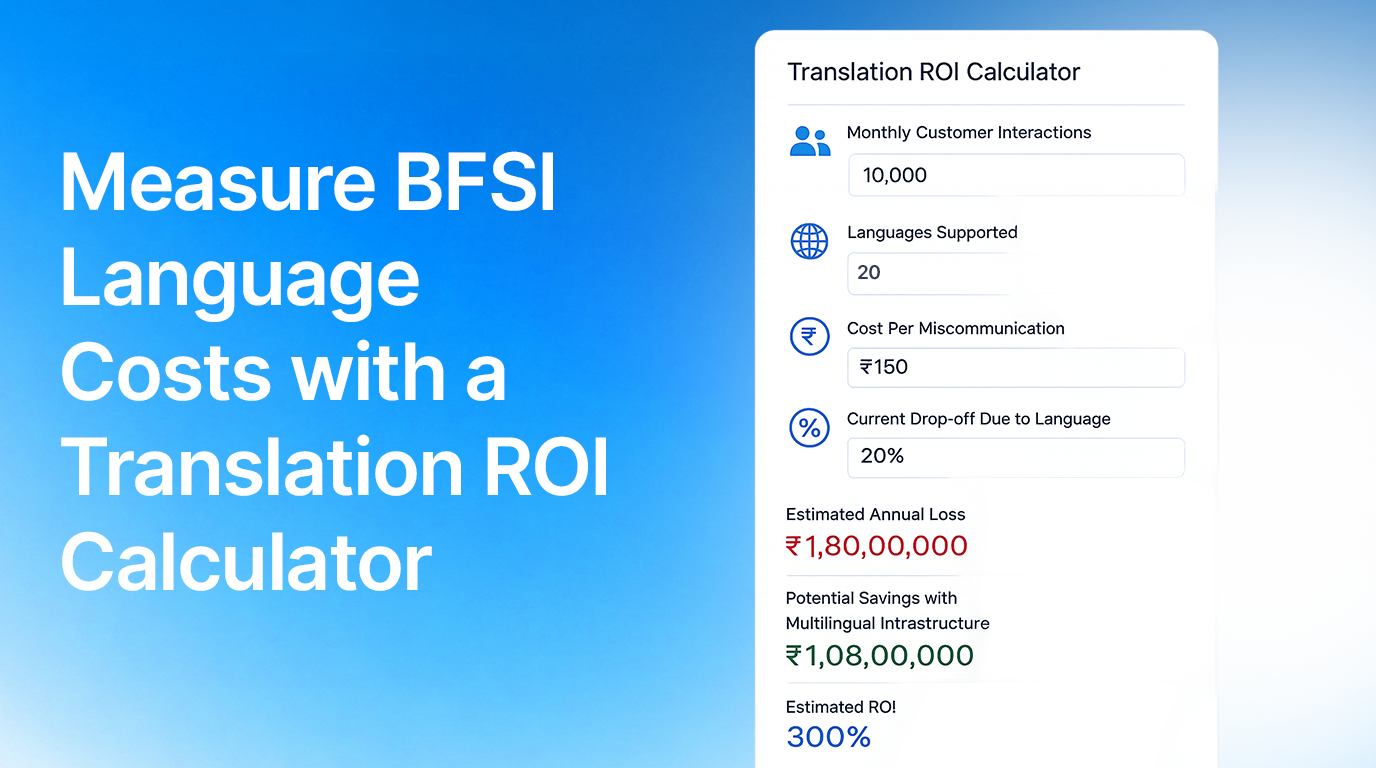
A translation ROI calculator fixes that. It turns a fragmented set of costs into one comparable figure. A CXO or operations head can then answer the question directly: is our current approach to language cheaper or pricier than a governed language AI layer, and by how much?
What Is a Translation ROI Calculator?
A translation ROI calculator is a framework, not a single formula. It takes your current language spend across people, vendors, and delays and compares it against what a language AI platform would cost to run the same workload. The difference is your return on investment.
What Does It Actually Calculate?
At its simplest, a translation ROI calculator answers three questions. What does it cost today to produce and deliver multilingual content, disclosures, and support across every language your customers use? What would the same volume cost through an AI-driven language infrastructure layer? And what is the payback period, once you factor in faster turnaround, fewer errors, and better compliance?
That third question is where generic translation calculators fall short for BFSI. A marketing team calculating ROI on translated blog posts only needs cost per word. A bank calculating ROI on a Key Fact Statement (KFS) translated into twelve languages needs cost per word, turnaround time, and an audit trail, all together.
Why BFSI Teams Need One, Not a Generic Version?
Generic translation ROI calculators assume static content: a webpage, a brochure, or a product description. BFSI language costs come mostly from workflows, not documents.
Think onboarding paperwork, loan disclosures, collecting scripts, grievance responses, and regulatory circulars. Each is dynamic, high-frequency and sensitive in law. A calculator created for BFSI needs to think about compliance risk and process integration, not just per-word translation rates.
Why Language Costs Matter in BFSI?
Language in BFSI isn't a support function sitting next to the business. It's the layer every regulated interaction passes through, and that's why its cost behaves differently than in other industries.
The Hidden Cost of Manual Translation
Manual language operations rarely show up as one clean expense. Instead, the cost spreads across agency or freelance translation fees billed per word, internal teams that review and re-approve translated content, delays between a policy update and its multilingual rollout, and rework when a translated disclosure needs correcting after the fact.
None of this appears as a single line item. That's exactly why most institutions underestimate what language actually costs them.
RBI, IRDAI, and DPDP: Compliance Makes Language a Cost Center
For regulated financial institutions, a translation isn't just a customer experience decision. It's a regulatory one.
RBI's KFS disclosure requirements, IRDAI's product disclosure norms, and the DPDP Act all treat a multilingual customer communication as a compliance artefact. The institution must be able to explain and evidence it later, in whichever language it was delivered.
That changes what "cost" means. A translated document that can't be traced back to its source policy version, or a chatbot response that can't be replayed in an audit, isn't just a language cost. It's a compliance exposure with a cost of its own if something goes wrong.
The Business Cost of Getting Language Wrong
Beyond compliance, language friction shows up directly in business metrics. When a KYC form feels like a literal translation rather than a natural one, onboarding drop-off increases.
Collections response rates fall when a reminder lands in the wrong tone or language and damages trust instead of prompting repayment. Grievance resolution slows down when a complaint filed in a regional language needs manual routing and translation before an agent can act.
Each of these carries a measurable cost, and each belongs in a proper ROI calculation.
Manual vs Language AI Operations
The clearest way to see the ROI case is to compare what manual language operations actually involve against what changes with a governed language AI layer.
What Manual Language Operations Actually Cost
A typical manual setup for a mid-sized BFSI institution involves an internal content or compliance team, one or more translation vendors per language, and a review cycle before anything goes live. Each new language adds another vendor relationship and review cycle, so cost multiplies rather than simply scaling with volume.
What Changes with a Language AI Infrastructure Layer
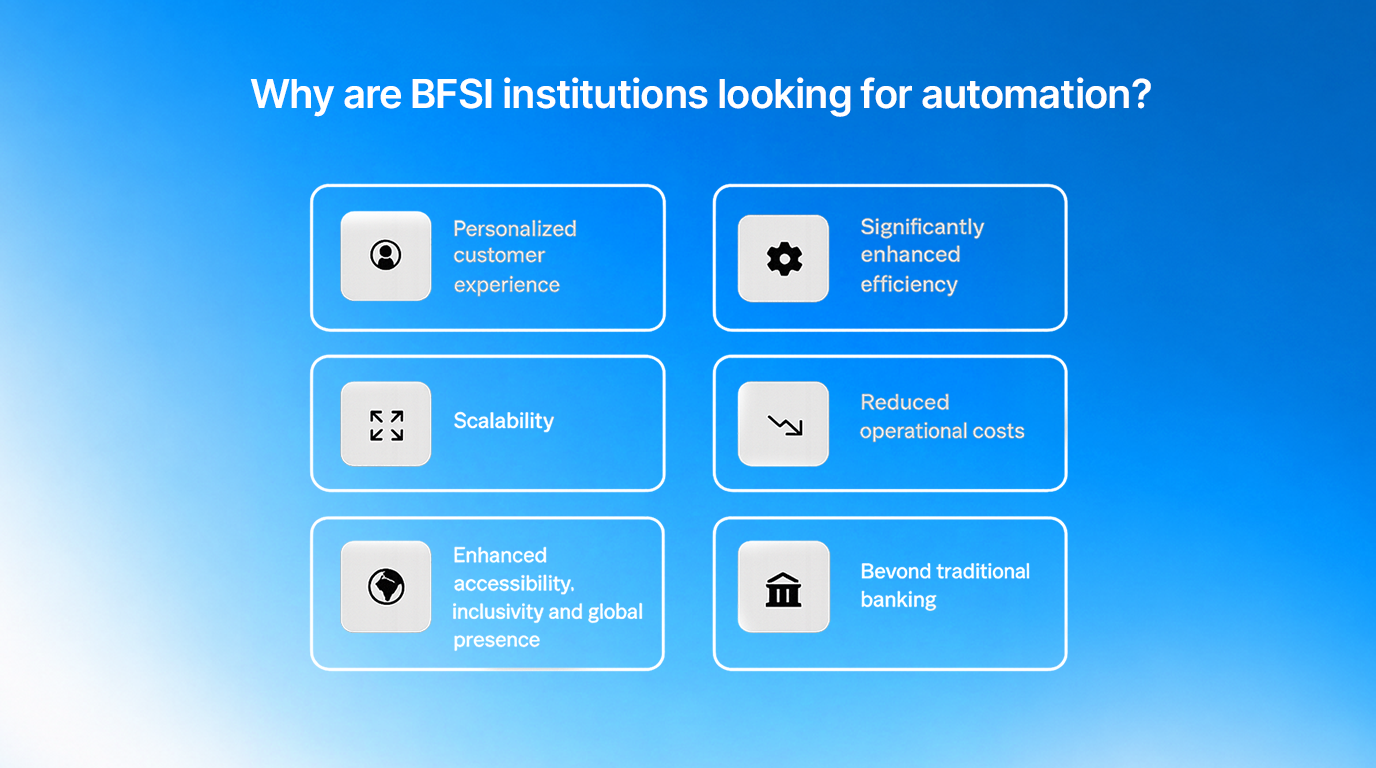
A language AI infrastructure layer changes the shape of the cost, not just the size. Instead of a linear cost per word per vendor, the institution pays for a platform that processes translation, transliteration, and conversational language at scale, with governance built in.
New languages become a configuration step rather than a new vendor contract. Content stays consistent across channels because it comes from one governed source.
Manual vs Language AI at a Glance
| Factor | Manual Language Operations | Language AI Infrastructure |
|---|---|---|
| Cost structure | Per word, per vendor, per language | Platform-based, scales with usage |
| Turnaround time | Days to weeks per update | Hours, often same-day |
| New language rollout | New vendor relationship and review cycle | Configuration within existing platform |
| Audit trail | Manual, often incomplete | Logged automatically at every touchpoint |
| Consistency across channels | Varies by vendor and reviewer | Governed from a single source |
How to Measure Language ROI?
Once you break out the manual and AI-driven costs, the ROI calculation itself is straightforward. The complexity lies in choosing the right inputs, not the arithmetic.
The Core Translation ROI Calculator
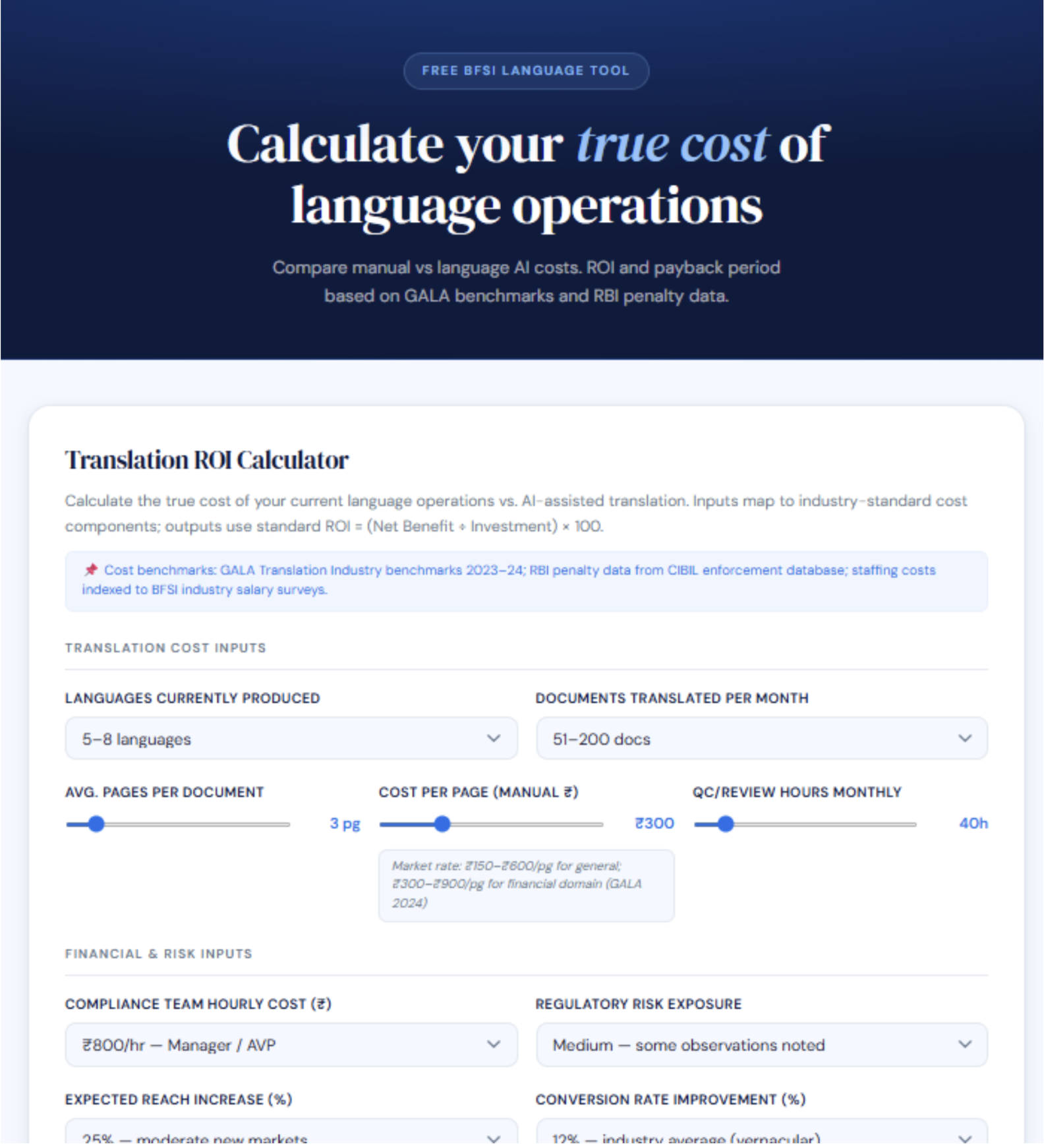
Generated value includes savings through reduced vendor expense and internal review hours. It also discusses the commercial benefit of faster, more accurate multilingual communication — including improved onboarding completion or collections recovery.
Inputs Your Translation ROI Calculator Requires
You need a BFSI-specific calculation that factors in the current annual cost with translation suppliers, the internal hours spent examining and approving the multilingual content, and the usual turnaround time from policy amendment to implementation.
Also consider the number of languages you currently support compared to your customer base's actual needs, onboarding completion rates, collections response rates segmented by language where possible, and the cost of a single compliance incident tied to a translation error, even if estimated conservatively.
Metrics Beyond Cost
The strongest ROI cases in BFSI rarely come from cost savings alone. A 25% uplift in onboarding completion or a 20-30% improvement in collections response shifts the conversation from cost reduction to revenue and recovery. That shift is usually what separates a pilot from enterprise-wide adoption.
A Worked Example
Consider an NBFC spending roughly ₹40 lakh a year across translation vendors for six languages. Turnaround averages ten days per disclosure update, and the internal review team spends 15 hours a week on corrections.
Now put a language AI infrastructure layer in place, covering the same six languages plus four additional regional ones. Turnaround drops to same-day. Internal review time falls by more than half. Onboarding completion improves because disclosures read naturally rather than as literal translations.
Run those numbers through the ROI formula above, and the platform typically pays for itself within the first year, before you even account for the reduced compliance risk of an auditable trail on every disclosure. Every institution's numbers will differ, but the shape of this calculation holds across BFSI.
Why Language AI Is the Future for BFSI?
From Point Solutions to a Governed Language Layer
Most institutions arrive at this decision after trying point solutions first: a translation API here, a chatbot vendor there, an in-house team stitching it together. Each solves one visible problem without solving the underlying one.
Language in BFSI needs governance as infrastructure, not management as disconnected tools. A language AI infrastructure layer like Devnagri AI builds that governance in from the start, connecting to existing core banking and CRM systems while maintaining an audit trail across every regional language interaction.
Why Now
Regulatory pressure around KFS disclosure and DPDP compliance keeps increasing. Customer expectations for native-language service, especially outside metro markets, are also rising alongside it.
Institutions that calculate their language ROI now put themselves in the best position to act, before the cost of delay compounds further.
Conclusion
The Bottom Line for BFSI Decision-Makers
A translation ROI calculator gives BFSI institutions something most have never had: a single, comparable view of what language actually costs and what it could cost instead.
Break out the manual costs honestly, including compliance risk and business impact, and the case for a governed language AI layer tends to make itself. Institutions that run this calculation early get to choose their language infrastructure deliberately, rather than reacting to it after a compliance gap or a customer experience failure forces the decision.