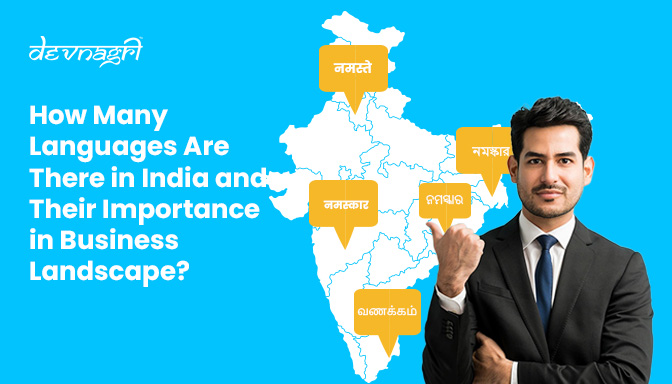
If you have ever travelled across India by train or even scrolled through regional YouTube videos, you know one thing for sure. This country does not sound the same everywhere. The accent, the script, even the words shift faster than the landscape outside your window. India is not one voice but a collection of thousands, blending and reshaping every day.
So, when someone asks how many languages India really has, it sounds like a simple question. It is not. The answer depends on where you stand, how you listen, and what you call a “language.” For businesses, that question also decides how far they can go in connecting with real people.
India’s Endless Language Map
Let us start with what is recorded. The 2011 Census of India mentions 121 languages that have more than ten thousand speakers. But when all dialects and local variants are counted, the number jumps beyond 19,500 mother tongues. Out of those, 22 languages hold official recognition in the Eighth Schedule of the Constitution, covering roughly 97 percent of India’s population.
You might think that settles it. Yet, newer studies tell an even richer story. The People’s Linguistic Survey of India lists nearly 780 living languages, and a Mother Tongue Survey by the Ministry of Home Affairs captured 576 languages and dialects through field research.
Even within Hindi, you will hear Bhojpuri, Haryanvi, Marwari, and Bundeli. They look related but sound entirely different. For a marketer, this means one ad or one chatbot message will never speak to all.
Why Language Matters More Than Ever?
India’s internet is growing faster than anyone imagined, but language decides who stays online. According to a KPMG-Google study, nine out of ten new internet users prefer regional content (source). Local-language users are increasing at nearly 18 percent a year, while English-speaking users grow by barely 3 percent.
This means that if your brand communicates only in English or Hindi, you are invisible to millions. The reality is simple: people do not just want to read in their language; they trust it more. When a banking app sends a notification in Gujarati, it feels friendly. When a learning platform explains a lesson in Tamil, it feels personal. That comfort often becomes conversion.
Enter the Translation API
At first, you might think multilingual communication demands endless translators. But technology quietly has an answer, the translation API.
In plain terms, a translation API connects your system to an automated translation engine. It may change the text on your website, product information, chat messaging, and even emails into the language your customer wants. All of this happens in real time with no need for manual work.
For example, a customer types a support question in Malayalam. The technology quickly changes it to English for your agent, who then replies in English. The response then gets back to the customer in Malayalam. The contact feels real, genuine, and local, and it's all powered by the API behind the scenes.
Why Translation APIs Make Sense for India?
There are several reasons businesses now depend on this approach.
First, speed. A translation API allows you to launch or update your platform in many languages at once. You don't have to recreate everything or hire a team of translators for each state.
Second, cost. After integration, adding a new language costs very little. It becomes a technical update instead of a budget conversation.
Third, being consistent. A set lexicon can help APIs keep your tone and terms the same in all languages. Your brand still sounds like a Hindi, Bengali, or Tamil phrase.
Fourth, adaptability. Modern translation APIs do not just translate fixed text. They can handle live user reviews, dynamic product details, and chat messages instantly.
And finally, they learn. Over time, machine learning models get better at being accurate. The more your system translates, the more it understands your brand’s phrasing and tone.
In a country as linguistically layered as India, that flexibility is not a luxury, it is survival.
Real-World Impact Across Sectors
You can already see translation APIs shaping outcomes in different industries.
Take eCommerce first. When product descriptions and customer reviews appear in local languages, shoppers stay longer and buy more often. Conversion rates climb naturally because people read what they understand.
In education, regional language support opens digital classrooms to students who were once excluded. It's easier to learn when the app speaks the same language as home.
Each number here hides a world, songs, stories, habits, humor. Hindi alone has about 528 million speakers, Bengali around 97 million, Marathi nearly 83 million, Telugu about 81 million, and Tamil close to 69 million.
Translation APIs are used by the banking and financial industry to develop apps, SMS alerts, and chatbots that can speak more than one language. Customers get instant help in their native tongue, which builds trust and reduces confusion about transactions.
Government websites also benefit. When public information is available in multiple languages, citizens can access schemes or fill out forms without needing help from others. It is digital inclusion in practice.
Even healthcare depends on it. Translating prescriptions, reports, or tele-consultation chats reduces mistakes and anxiety. Clear words can literally improve patient safety.
One private bank recently integrated automated translation into its chatbot. Within three months, customer satisfaction scores jumped by 28 percent. People felt heard, and the bank noticed fewer escalations.
How Businesses Can Begin?
The first step is always a language audit. Look for where your customer journey breaks because of words. Is it your website copy, your mobile app, or your customer support flow?
Next, choose a translation API that supports all major Indian languages and dialects. Devnagri’s solutions, for example, are built around Indic language expertise.
Then, feed it your company’s style guide. This ensures that the translated content does not lose your tone. Start small. Pick two or three key languages. Track metrics like session duration, bounce rate, or resolution time. As soon as you see impact, extend coverage to more regions.
And remember to invite feedback. Native speakers can refine small details that make translations sound local, not machine-made.
India’s Multilingual Future
Tomorrow's digital India will have even more languages than now. If you look at what Statista projects, India might cross 900 million internet users by 2025. That is almost the size of a continent going online. But what is more interesting is that most of these people will not be reading in English. They will scroll, search, and shop in the language they grew up with.
As regional OTT platforms, digital payments, and voice tools keep spreading, translation will quietly blend into everyday life. You will not even notice it happening, an app that talks in Marathi, a chatbot replying in Kannada, or a movie subtitle switching to Assamese. For companies already using translation APIs, this shift will feel natural. Their systems will not need to catch up, they will already be part of the change.
Being multilingual will not be a competitive edge anymore. It will be the cost of entry into India’s digital market.
Closing
So, how many languages are there in India? The number keeps shifting, somewhere between hundreds and thousands, depending on how you count. Each one stands for a group of people who want to be accepted on their own terms.
For businesses, the goal is simple: speak in the language your users think in. When you do that, you are not just translating text, you are translating emotion.