Think about this. A global brand is preparing to enter a new market in a different part of the world. The product and marketing budget are reasonable, but the campaign isn’t going well. The reason is not the proposition itself, but how it talks to people. Messages written in a single global language miss the emotional pulse of the local audience.
This is a familiar story for business leaders. Expanding across markets requires more than translation. It requires localization that respects culture, language, and context. If your content feels foreign, customers are less likely to engage. If it feels familiar, they lean in.
Over the past few years, localization has moved from being a nice-to-have to being a core growth lever. It affects how fast you gain trust, how deeply you connect, and how consistently you grow. In this blog, we will walk through seven approaches that make localization a strategic advantage. Along the way, we will examine the role of English to Kannada translation, hybrid workflows, and technologies like machine translation APIs in helping businesses succeed.
1. Begin with Cultural Mapping
Every market has its own sense of humor, morals, and methods of talking. For example, it would be a bad idea to go to Karnataka without knowing what Kannada-speaking customers want. The language is only one part of it. Culture is the larger frame.
Back in 2020, Common Sense Advisory studied consumer behavior across countries and found something striking. About three out of four people said they prefer to buy from websites that present information in their own language. That is a simple but powerful truth: comfort builds trust.
Cultural mapping means investing time to learn idioms, social references, and even the pacing of communication in your target market. A campaign that feels like it was built for “people like me” will always land better than one that looks like a generic global message.
2. Use Hybrid Workflows Instead of Choosing Sides
The debate between machine translation and human translation has been going on for years. Machines give you scale and speed. Humans provide you with nuance and empathy. Most global players now realize they do not have to choose.
A machine translation API can provide the first draft of large volumes of content. Then, experienced editors check the tone, rectify problems, and make sure the content matches the culture. Nimdzi Insights says that businesses that employed this hybrid method were able to decrease their time to market by around half in 2023 while still keeping the same level of quality.
Consider how a store prepares for festival sales in Kannada. An automated system takes care of thousands of product descriptions every night. People who review change sentences to include idioms and phrases that are common in specific locations and on certain holidays. The business gains both speed and a connection to the local community.
3. Build a Central Multilingual Hub
Scattered files, inconsistent messaging, and duplicated translations are common pain points for growing organizations. A multilingual content hub solves this. It becomes a single source of truth for all localized material.
Think of it as a library that stores blogs, white papers, customer guides, and FAQs in every active language. When a team member needs the English to Kannada translation of a product manual, it is ready, reviewed, and consistent. McKinsey research shows that organizations with structured localization systems report around 15 percent higher adoption of localized content across their business units.
The hub is not only about efficiency. It also reinforces brand voice across markets. That consistency is what protects a brand from being diluted as it expands.
4. Adapt to Local Formats and Channels
Localization should not stop at text. The medium itself carries meaning. A message written in Kannada may still miss its target if it is delivered on a channel that the audience rarely uses.
Take a short-form video. Research by the Content Marketing Institute in 2022 showed that localized video content achieved roughly double the engagement of non-localized content. In some regions, consumers rely more on community-driven apps or audio content. In others, influencer partnerships in the local language outperform paid ads.
The lesson is straightforward. To truly connect, adapt both your message and the way it travels.
5. Optimize for Local Search
Many companies fall into the trap of translating keywords directly. Yet search habits are rarely that simple. In Kannada, for instance, the phrase people use for “investment opportunity” may differ from the direct translation. If you don’t comprehend that subtlety, your stuff will be undetectable.
When you do localized SEO, you seek for keywords that are common in the area and utilize them naturally in titles, metadata, and content on the page. According to SEMrush, websites that used localized SEO received a 20 to 30 percent rise in organic traffic after they were optimized in 2021.
In practice, this is one of the fastest ways to generate inbound traffic in new markets. Visibility is not about being present; it is about being searchable in the way locals think.
6. Measure What Localization Delivers
Executives often ask the same question: Does localization pay off? It depends on how you measure it.
Monitor key metrics, including how long people stay on a page, conversion rates on localized landing pages, sales growth in the local market, and customer satisfaction. Here is a practical example. A company rolls out English to Kannada translation for its e-commerce site. The team sees that the Kannada pages have a 20% higher buy rate than the English pages when they look at conversions independently. That kind of information makes localization go from an abstract cost to a clear investment in growth.
7. Create Processes That Scale
A single regional campaign is manageable. Scaling into ten new markets is where leaders feel the strain. Without process, localization becomes expensive and chaotic.
The answer lies in creating style guides, glossaries, and translation memory databases that travel with you. Tie these to your machine translation API so that every new piece of content passes through the same pipeline. Nimdzi reported in 2022 that organizations investing in scalable localization infrastructure expanded into new markets 30 percent faster.
This is not about over-engineering. It is about building a system once so that every new market can be launched with confidence.
Pulling It All Together
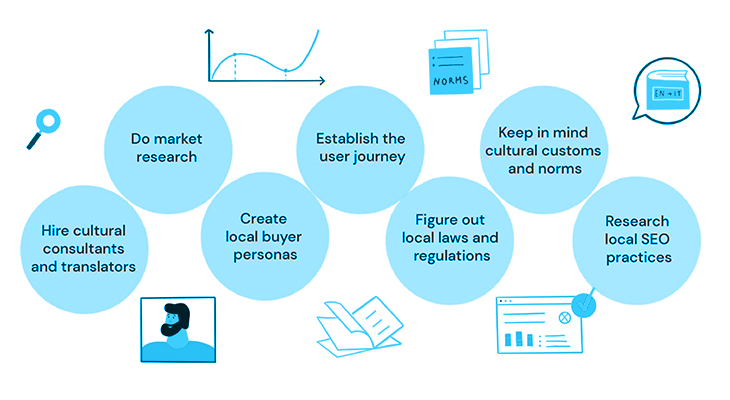
One e-commerce brand that came to southern India used a number of these methods. They started by looking into Kannada festivals and family themes in their culture. They optimized for Kannada search behavior and tracked results carefully. Within six months, the company saw conversion rates on Kannada-language pages climb by 20 percent compared to the English pages. That was enough to cover the localization investment several times over.
Conclusion
The global marketplace is crowded. What separates winners from strugglers is not always product quality or budget size. A lot of the time, it’s about being able to talk to each group in a way that feels natural to them.
Following a set of rules isn’t enough for content localization to work. It’s a plan. You can get more people to connect with your content and make more money by using cultural mapping, hybrid techniques, multilingual hubs, local channels, SEO, ROI tracking, and scalable procedures all at once.
Business leaders seeking international growth should view localization as a key strategy. Kannada-speaking areas are not peripheral markets. They are substantial, growing audiences waiting to be addressed in their own language.
Now is the time to put these approaches into practice. Start with one campaign, measure its impact, and expand from there. The results will show that localization is not only about speaking differently. It is about being heard more clearly.